

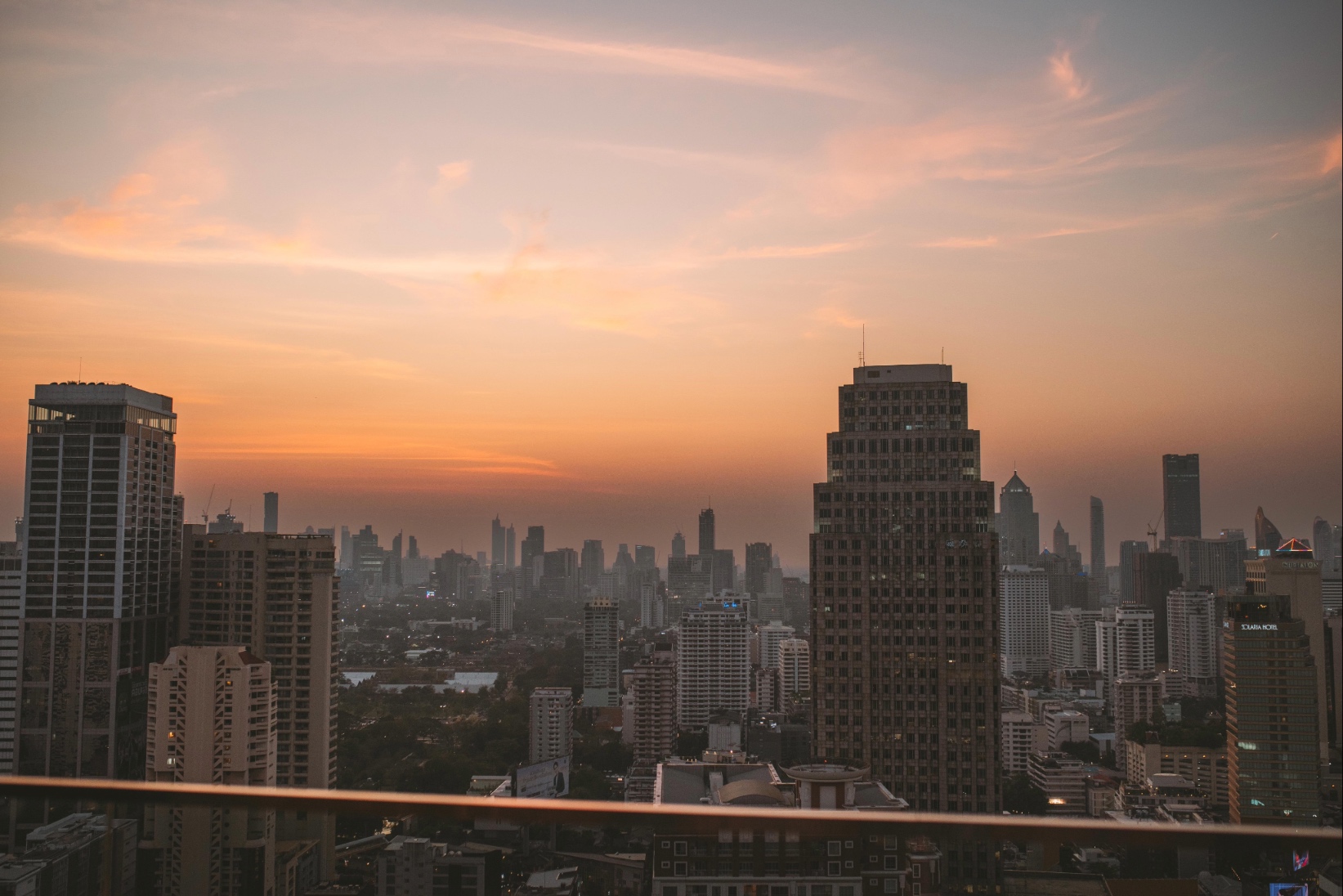
Bangkok is not more than just a city. It’s a living organism that has grown into the largest primate city in the world over the past 244 years. This tale of urbanization and development is one of fascinating stories of Thailand which profoundly impacts the realities of the world’s largest Theravada Buddhist country. Bangkok is a waterborne city that expands 1,568sqkm (within borders) or nearly 8,000sqkm (beyond borders) into the marshy environs of the Chao Phraya river basin. It is home to an estimated 17 – 20 million people (greater metropolitan area) and one of Southeast Asia’s most important cultural and economic hubs which accounts for nearly half of the Thailand’s GDP of approximately 560 billion usd. At first glance it’s a city studded with an immense skyline, huge megamalls, nightlife, massive infrastructure and notorious traffic but beyond the facade we aim to reveal the inner workings of Bangkok and trace the city’s transformation from a waterborne port to a global megacity. Bangkok is often described and loved for its energy, chaos, people, food and contrasts but its sheer size and onslaught on the senses can be confusing and intimidating. We peel away the urban layers, the logic by which it came to be which did not erase a previous logic but co-exists with it and creates the immense contrasts that people find mind boggling.
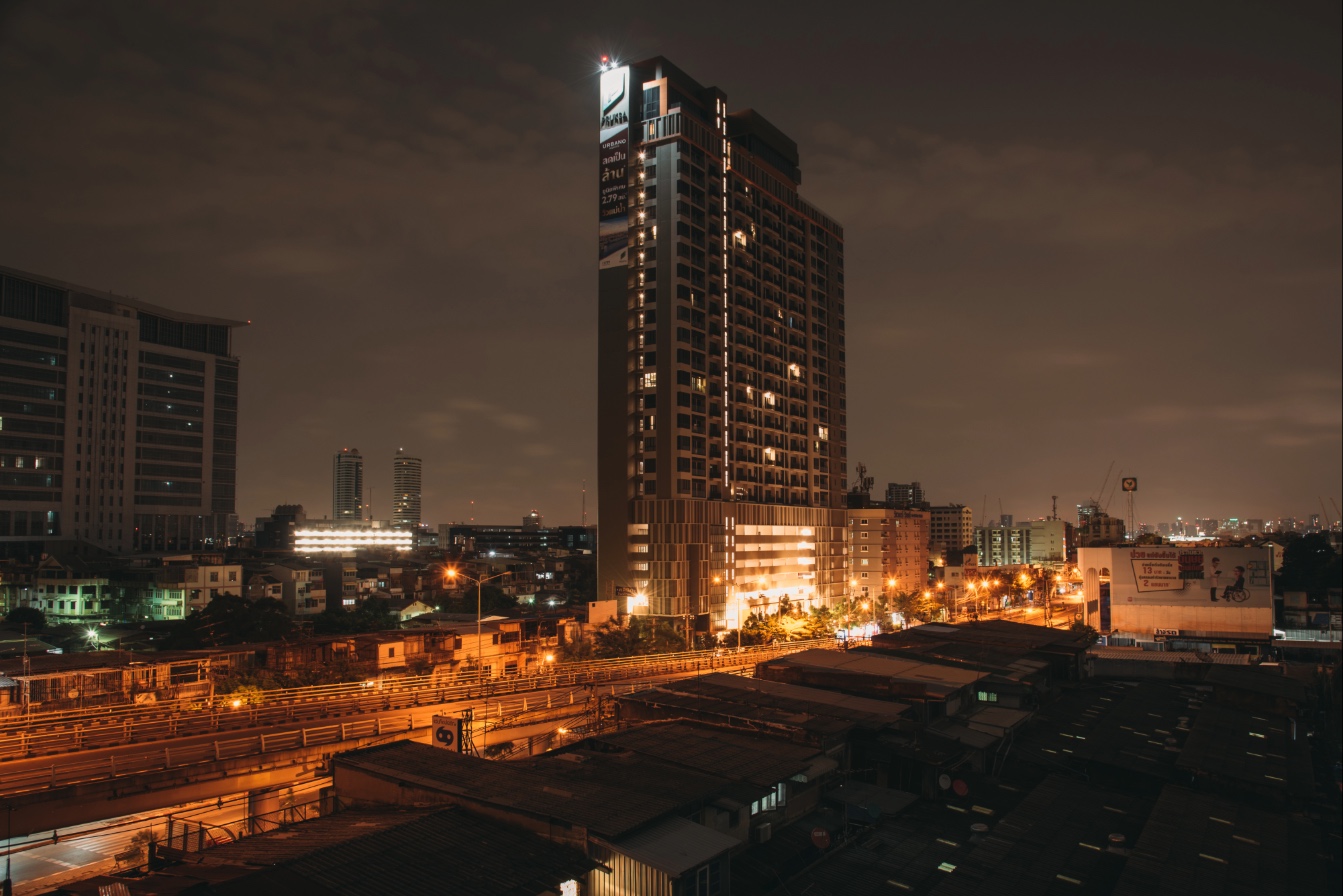
The middle class goes vertical
THE COSMIC FLOATING PORT 1782 – 1850s
When Ayutthaya fell to the Burmese in 1767, Siam fell into anarchy without a capital and a functioning state. It took several decades and two governments to wrest back control and establish conditions of unity, statehood and security. First in 1767-1782 Thonburi under Taksin and then when the Chakri dynasty found Bangkok in 1782. As Bangkok rose from the ashes of war, internal power consolidation and an emphasis on security did not allow outsiders to enter the kingdom. Siam isolated itself from the rest of the world as it rebuilt. In the early 1820’s more than half a century later westerners were eventually able to set foot into the Thai kingdom. The world they found was one of mystique and adventure. Ayutthaya lay abandoned in ruins 80km north of the riverbend that had now become the nucleus of a young and ambitious Buddhist empire. That river bend was surrounded by concentric moats to the east, creating a city of islands ringed with city walls and fortifications and the golden spires of Buddhist temples and palaces while floating houses from timber and bamboo formed endless rows moored along the river banks. People lived with the gravitational beat of the moon and the monsoon season. Heavy rains, tides and annual floods determine the type of living suitable in such harsh and tropical conditions. Most dwellings were made from organic materials. Only temples, palaces and wealthy Chinese merchant homes were made from brick which are not ideal structures in a marshy environment that sits only 1 meter above sea level. Bangkok was named and mentioned in ancient French maps after hog plums grown in the area. Bang Makok – Bang (village by the water) Makok ( hog plum) together it becomes Bangkok, a name tracing back when it was a small outpost on the way to Ayutthaya. That name however is unworthy for the role that Bangkok was to play as the heart of a new Buddhist kingdom. Within the city walls surrounding inner Rattanakosin lived the Buddhist monarch, his family and the aristocracy. The fortified citadel that was the center is still called Rattanakosin (Jewel of Indra) and the entire name bestowed for Bangkok is:
Krungthep Mahanakhon Amon Rattanakosin Mahinthara Ayuthaya Mahadilok Phop Noppharat Ratchathani Burirom Udomratchaniwet Mahasathan Amon Piman Awatan Sathit Sakkathattiya Witsanukam Prasit
This translates as: “The city of angels, the great city, the eternal jewel city, the impregnable city of God Indra, the grand capital of the world endowed with nine precious gems, the happy city, abounding in an enormous Royal Palace that resembles the heavenly abode where reigns the reincarnated god, a city given by Indra and built by Vishnukarma.”
The references made to Indra links to the political identity, as the new Bangkok dynasty had no direct blood relations to the dynasties of Ayutthaya. God Indra was chosen as the symbol for the founding king to emulate and aspire to. Indra is the god king, dwelling in the highest spheres of the cosmic axis Mount Meru and the protector of the Buddha. When Bangkok was founded King Rama I asked one of the fundamental question which was about the origin story of Indra. This is important because not only is Indra the protector of the Buddha and the Dhamma (Buddha’s teaching) which is the principle role of a righteous Buddhist king but also the fact that good deeds and merit accrued lead to being incarnated as Indra. This origin story and karmic achievements would provide the political legitimacy to rule. Today, Indra riding his sacred elephant Erawan is the logo of the Bangkok Metropolitan Administration.
A CITY OF TEMPLES, CANALS AND VILLAGES
While within the royal citadel (Krungthep) the periphery was still Bang Makok as the surrounding areas were build on swampy land with canals and floating villages where people settled as refugees, war captives, crafts people, Portuguese mercenaries, traders from near and far, Chinese, Muslim, Cambodians, you name it. Many fled, others were brought from the tributary states to fill the lands with more people. What is a kingdom without people? How do you fight wars? What’s the point of being the lord of the land but you can’t reap the fruits of your trees? Through conquest and punitive campaigns additional populations were relocated into the central plains propping up Siam’s population. In the 1840s and 1850s migration and trade led to economic and population growth. The city had to be expanded and the new city boundary was marked by the Khlong Padung Krung Kasem canal dug in 1852. The last and outermost of Bangkok’s concentric canals. By then the need for moat defense against invasion became obsolete and the sacred mandala hierarchy gave way for the reality of trade and migration.
The palace precinct at Rattanakosin was still the nexus of the Theravada Buddhist world and grew into a hegemon in Southeast Asia. Especially throughout the 1840s Bangkok became an important port built on junk trade with China. King Rama 3 a skilled business person and devout Buddhist used much of the maritime trade profits, state taxation, and elite patronage to build new and renovate many of Bangkok’s iconic temples including Wat Pho. Among the many city states in the region Bangkok grew to become the demographically and economically most powerful one and exerted influence and control over large territories ranging from the mountains of Laos, Cambodia and down to the Malay peninsula. The regional hegemon was still steeped in a feudal, Buddhist world but the West, through Britain and then France became its new neighbor and started probing and pushing for neighborly relations based on a Western understanding of statehood and foreign relations. The indigenous politics of a mandala state organized through hierarchical relations without clearly defined territories (borders) came increasingly under pressure.
TREATY PORT AND WESTERN LED DEVELOPMENT 1860 – 1880s
As the influence of Western statecraft, science and economics grew Siam’s leadership had the foresight and intelligence to adapt to the new realities and chose a Western led path of development without giving one’s identity. One could reconcile science and technological advancement with traditional beliefs and Buddhism. One could westernize on the surface yet remain Thai inside. The West did not have to kick in the door, Siam opened it from the inside. This ambivalent relationship culminated in the Bowring Treaty of 1855 which opened Siam’s economy for free trade. This was done under the reign of King Mongkut (Rama IV) who planted the seeds for reform that his son King Chulalongkorn (King Rama V) would carry out later. While modern geography was introduced to Siam and mapping became an important tool, King Mongkut commissioned the first modern street Charoen Krung road which opened for traffic in 1864. Charoen Krung Road was the first western style road designed for horse drawn carriages and connected the three emerging centers along the Chao Phraya river: The European quarters, the Chinese port and merchant district and the palace district Rattanakosin. A walk along this historic street today is a journey through the past and future of Bangkok. It’s the most diverse and historically important street in the city. Along its 8.6km length, you’ll find everything from ancient European historic cemeteries to Bangkok’s most trendy neighborhoods. Charoen Krung was a sign for things to come in a city and culture that was still aquatic in the mid 1800s. 1860’s saw the construction of additionals streets and within the royal citadel such as Bamrungmuang and Fueng Nakhon Road. Commissioning new streets came hand in hand with the construction of shophouses. This era was the beginning of the proliferation of the sino-european shophouses built in rows along newly paved roads or commercial canals. They were the first generation of brick and masonry commercial buildings and became the early urban corridors of Bangkok. You can still find remnants of these shophouses in the old neighborhoods of Bangkok.
Royal modernization 1880 – 1920s
King Mongkut’s son King Chulalongkorn was the monarch that Thai people credit for modernizing and bringing Thailand into the modern world while staying politically sovereign among a continent that was colonized by European empires. It was a time of rapid change, accelerating the shift from a waterborne city to a landbased one. Many delegations and diplomatic missions set up bases and the community of Europeans grew into several hundreds. Many of the early expat community worked for the government as consultants and in charge of modernization and infrastructure projects. The 1890’s saw the first rail line going down to Paknam, telegraphs were already decades earlier but part of the strategy to avert colonization was to built a nation that was civilized, that Siam wasn’t the barbarians waiting to be civilized but they were already civilized and the great projects of the late 19th century was to bring some of the amenities and grandeur of European cities to Bangkok to make it look Western. The construction of the Ratchadamnoen Boulevard, Hua Lampong Station, the transformation of Chinatown into an efficient port, the expansion of Asia’s first tram system, a new modern, administrative government system in Dusit, away from the traditional symbol of authority the Grand Palace among many other landmarks and areas defined the development of Bangkok from the 1880s onwards. The project of nation building and modernization was carried on by his son who shifted from infrastructure development to Thai nationalism, education and western institutions given the geopolitical climate moving into the 20th century.
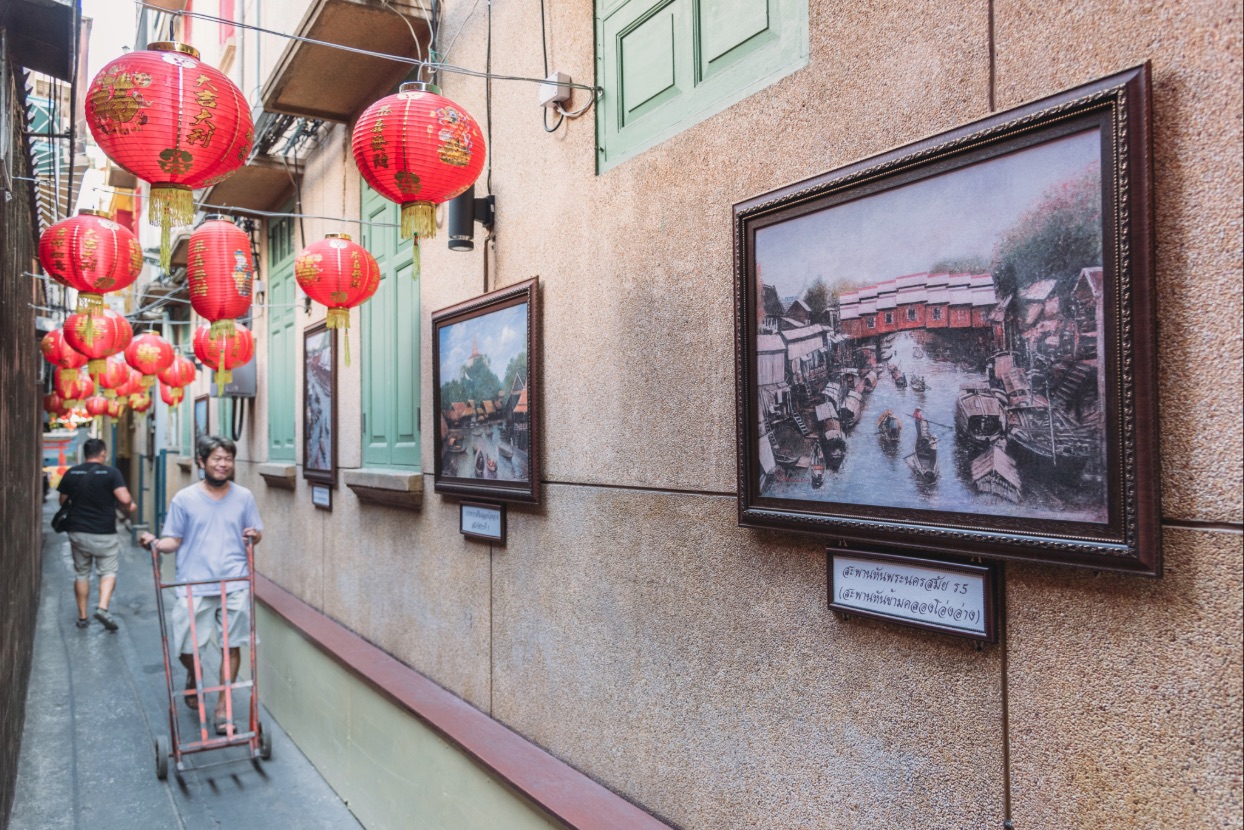
The painting on the right depicts the Saphan Han Bridge built as a replica of the Ponte Vecchio in Florence. One of the modernizing aspects brought to Siam after King Chulalongkorn’s visit to Europe.
Bangkok at the turn of the 20th century had grown into a modern and cosmopolitan city. Connecting Siam with the colonial markets transformed agriculture which led to an the expansion of the canal system in central Thailand. Despite the focus on road construction, canals still played a pivotal role for transportation. From the British colonies of the Indian ocean came people and new products while mass migration from China ensured that labor needs for the economy, industries, rice milling, and infrastructure development were met. A large Chinese labor class and very wealthy merchant and capital class created Bangkok’s early bourgeoisie. The Chinese were occupying most of the professions and dominated entire industries. Indians, Tamils, Sikhs, Cantonese, Hailamese and countless other minorities made up three quarters of the city’s population of roughly 600,000. Areas like Chinatown were so densely populated and impoverished that King Chulalongkorn upon a journey to a Buddhist temple in Sampeng was so shocked by the squalor that he immediately commissioned most Chinatown’s main roads and the modernization of the port creating today’s famous and trendy neighborhoods such as Songwat Road.
The nationalist capital 1930 – 1940s
In 1932 Bangkok inaugurated the Memorial Bridge and a statue of King Rama I in honor of the 150th anniversary of the Chakri dynasty. The Memorial Bridge allowed Bangkokians to cross the river on foot or by car for the first time and the construction led to a major road building project on the Thonburi side such as the Wong Wian Yai roundabout. However the same year also saw the end of the absolute monarchy in 1932 and the takeover of a new nationalist government which changed the name of Siam to Thailand in 1939. The era of hyper nationalism came into full swing as the Democracy Monument was inaugurated in the same year Siam changed its name. The Democracy Monument was symbolically placed at the center of Ratchadamnoen Avenue (royal pathway) to commemorate the Siamese Revolution of 1932 and the abolition of the absolute monarchy. Ratchadamnoen and the Democracy Monument remain potent sites for political expressions and protests. The era of a new nation showed in the facades and architecture which shifted away from ornate, colonial or Euro-Chinese styling to a functionalist, Art Deco and early modernist aesthetic. Besides the political symbolism Bangkok continued its transition from water towards road and expanded away from the river and canals far beyond the outermost concentricness of the ancient mandala. Bangkok began to grow north and east into the Sukhumvit, Rama IV, Lad Prao, Silom Road, Sathorn, etc. These roads interconnected with a street grid that had already formed outward during Chulalongkorn’s era and was to become the central business district of today. Despite the urbanization and increasing number of motor vehicle the 1940s were still a decade where my grandmother did cross-provincial travel by boat to sell coconuts harvested on our farms in Samut Songkhram and sell them at the floating markets in Bangkok. But the shift was clear as the population grew from over half a million before world war 2 to over 1.5 million by 1950 the city continued to absorb a rural to urban migration and a population of over 2 million in the 1960 began to push the capacity of what the environment and public utilities could manage. Floating houses were banned in the 1960s because of water pollution, rickshaws and the tram were replaced by public buses and as Bangkok moved into the 1960s the era of Americanization and economic development plans came into effect laying the groundwork for Bangkok to grow into the largest cities in Southeast Asia.
The development state 1950s – 1970s
In the 1960s and 1970s the economy of Thailand was still largely a plantation economy. 84% of Thailand’s population were still farmers and by 1960 roughly half of Bangkok’s population still lived either by or near the water. The 1960s were a decade where King Bhumiphol met Elvis Presley and Thai-U.S. relations were at its peak. When Field Marshal Sarit Thanarat took power in 1957 he turned Thailand into America’s most important partner in the cold war against Communism and secured foreign aid for infrastructure and economic development. Some even refer to the 1960s and 1970s as the era of Americanization. Decades in which the transformation from an agrarian toward an industrialized country picked up steam and much of the country’s vernacular heritage fell victim to the unrelenting expansion and modernization of Bangkok. With the assistance of the World Bank, the Office of the National Economic and Social Development developed Thailand’s first National Economic Development Plan. ‘Development’ became essentially the state’s ruling idea. While large parts of the country were still in poverty, economic policy and development plans set by the military government, foreign advisors and technocratic planners steered money into industries clustered in the growing metropolitan region. Bangkok’s golden age of industrialization created a huge demand for labor and U.S. influence created many job opportunities and drew people from all corners of Thailand to Bangkok. The demand for labor, white collar workers in the increasing number of offices drew people from all regions of Thailand, especially the northeastern Isan region.
Even my mother, when she was eighteen years old, packed her bag and left the coconut farm in Samut Songkhram for a job in Bangkok. The city’s population tripled from about one million in 1950 to three million by 1970. This time there was a significant shift in the racial division of labor. Until 1949 most of the migration to Bangkok came from China but in the second half of the 20th century most newcomers were Thai villagers, especially from the poorer Northeast, arriving on new highways and by train at Hua Lamphong. The Chinese became the entrepreneurial class and middle class while the labor class turned to Isarn, Laos and later increasingly to Myanmar. The 1960s and 1970s brought thousands of U.S. soldiers on R&R to Bangkok, with them came money, hotels, nightlife, bars and steakhouses. My mother worked in the kitchen of an American restaurant in Sukhumvit. She worked 7 days a week and even slept there. Sukhumvit, New Phetburi Road, Silom Road became American hubs, some notorious for the red light districts and others said to host secret offices of the CIA. Universities and hospitals proliferated and Bangkok saw Siam Center, its first international shopping mall open in 1973. The American era was also the golden age of architectural modernism in Thailand, a bold transition toward a tropical adaptation of modernism and Bangkok brutalism. The sun breaker devices Brise-Soleil applied to modernist shop houses became Bangkok’s new default style along the modern thoroughfares. Bangkok’s first highrises such as the Dusit Thani hotel were soaring above 30 storeys boasting Thai Modernist style. Dusit Thani, like many postmodern buildings of that period, were eventually demolished in recent years. The influence of consumerism, media, Hollywood in the following decades led to a perception that the traditional way of living e.g. wooden houses on stilts, by the water, etc. was backward. A kid would be ashamed to raise his or her hand in class when asked who lived in a wooden house. The new Zeitgeist and the booming economy went into maximum overdrive when Bangkok was connected to Wallstreet, speculative investments and massive investments by Japan after the Plaza accords.
BOOM AND BUST 1985 – 1997
My first visits to Thailand were in the early 1980s, visiting grandma as a kid during German summer holidays. My family spent four out of six weeks on the coconut farm and a few days in Bangkok. I remember taxis having no airconditioning and how hot and nauseating the stop and go traffic in Bangkok was. I remember cars, lots of cars and pollution. When industrialization gained momentum in the 1980s so did environmental degradation. Some folks said that 1980’s Bangkok was probably among the most polluted places on the planet. The city grew at a breakneck speed and zoning regulations? What’s that? Environmental laws? Mmhh… Let me think. Inadequate laws or law enforcement while the city grew from 4 million people, roughly the size of Berlin in 1980 to over 10 million by the late 1990s. Nobody could really tell how many people lived in Bangkok as people don’t necessarily change their residential registration. Millions would go forth and back, seek work for a few months and return to their fields for harvest or planting. Bangkok’s been Thailand’s industrial heart yet beating at the rhythm of agrarian cycles. Regardless of how many people were registered or not by the 1990s it was obvious a megalopolis was rising from the low-lying riverbasin that would come to dominate the kingdom’s politics, economics and culture like no other city on earth.
HYPER GROWTH – FRICTION AND POISON
The urban hypergrowth came with friction, often when something new came something old had to go. Urban communities and rural villages that existed for centuries now stood in the way of a new highway ramp. It was a time of struggle between civil society and those with money and authority. The implications of rapid urbanization defined Bangkok’s structural change in the later second-half of the 20th century and is still true today.
MIGRATION AND INEQUALITY – KHLONG TOEI’S CHANGEMAKERS
Canals gone, roads clogged and still not enough space for the 1,000 – 1500 daily new registered vehicles so in the 80s Bangkok built on top, double-layer express ways were the answer. Bangna Trat Expressway, Rangsit expressway, Hopewell project, some engineered by German construction companies became the seventh longest bridge/viaduct in the world (Bangna Trat), others were never completed (Hopewell) but no matter how many millions of cubic meters of concrete were poured into giant expressway structures, crossing the city still meant taking a vacation. The city was imploding on itself. Public works had to push for new, bigger and better and the old and traditional got wiped off the map. Bangkok’s plantations, canals and paddies got devoured and metabolized into suburban housing, factories, shopping malls or remained as slums in a ‘semi rural – semi urban’ environment that wasn’t liable to zoning laws. As Bangkok’s biological layers disappeared under a cover of concrete, industrial areas got even more crowded. Port areas such as Khlong Toei were known for their affordable housing attracted tens of thousands of migrants. They worked at the docks and the nearby business areas of Sukhumvit. To this day many people still live in precarious conditions along rail tracks, polluted canals and beneath elevated expressways. When the situation became untenable, people such as Duang Prateep, Father Joe and others tackled the inequality and problems of Khlong Toei. While the city had never seen so much wealth concentrated yet had also never seen as many people living in such poor conditions. Today Khlong Toei is still home to roughly 100,000 people spread across land owned by the port authority. Their future is uncertain with plans under way to redevelop the Khlong Toei port into a mix-used development of hotels, retails and offices. Established organizations such as Duang Prateep have built their welfare systems that has been supporting thousands while newer organizations such as The Khlong Toei Music program contribute to narrow the gaps in one of the most unequal countries in the world. What their future hold has to be seen but their work and dedication will forever be remembered in the history of the area.
THE CHANGING OLD HEART – CHINATOWN AND OLD TOWN OUTWARD MIGRATION
Khlong Toei and other sprawling inner Bangkok neighborhoods became the catchment area for rural migration. Massive influx of people from Isan and other parts of Thailand met with a migration away from the traditional areas of Bangkok such as Sampeng and Phra Nakhon. Bangkok’s old Chinese middle-class, nobility and official class of the city’s old centers moved into the new suburban gated communities which sprung up like mushrooms after a warm rain. The alleys and homes once over populated filled with families and workers from rural Thailand. Phra Nakhon’s alleys such as Trok Sin and Duek Din are home to the largest concentration of wooden houses belonging to the nobility of Bangkok. Chinatown’s Sampeng and Songwat areas were still important for SME’s and trade companies but U.S. inspired economic development and consumerism gradually pulled the Thai-Chinese entrepreneurs away from Chinatown and into new emerging economic centers of Bangkok. The port had already moved to Khlong Toei in the late 1940s. The crowded and heroin and opium infested domains of Chinatown eventually turned into wholesale markets, textile, toys, machinery and electronics. As the Chinese benefited from the economic boom, buying all the new fancy household appliances and cars did not match with the dense and confined living conditions of Chinatown’s narrow laneways. Parking your brand new Mercedes in your living room on the ground floor wasn’t a longterm solution and the exodus into the suburbs of a car-centric city began. The economic windfalls of Thailand’s industrialization fueled an unprecedented boom of modern urban living in gated communities and condominiums. White collar workers, mangers, engineers, were in high demand. Sampeng’s role as the heart of the Chinese diaspora diminished dramatically but retained its commercial vigor. Chinatown from the 1980s onwards was not just busy but oppressively busy. While the mallification of Bangkok through the arrival of megamalls in the 1980s was under way Sampeng, Khlong Tom and Saphan Lek markets became established commercial centers focusing on everything from mass produced and cheap stuff to electronics, toys, hardware and so on. Well into the 2000s more than 350,000 people streamed into Chinatown daily to buy and sell stuff. While Bangkok’s economic activities and big business moved east into the new central business district, the old riverine neighborhoods from Chinatown all the way to Tha Tian became the city’s chaotic, diverse and colorful market belt.
THE SOUTHEAST ASIAN VERSION OF NEW YORK IN THE MAKING
For me it didn’t make much of difference. Whether it was Chinatown or Sukhumvit. I remember chaos and energy and I remember dust, a lot of dust from constructions, especially around the outer ringroads that were expanded. Churned reddish earth to cut new roads, cranes atop concrete skeletons. Everything was on the move, forward, upward, sideward, tuk tuks, buses, motorbikes, elephants with mahouts from the forests, total anarchy that I could only escape in one of those glitzy, airconditioned temples of consumption. By the mid 1990s some of Asia’s largest malls had opened their doors. Bangkok’s 1990s phase to become a global city and Asia’s number one shopping destination came with a massive construction boom. Big hotels, convention centers, banks and megamalls bearing names that evoke the grand mega buildings such as World Trade Center, Landmark Plaza, CP Tower, as an impressionable teenager it had a different ring to my ears than Karstadt in Hückelhoven. I felt as if I were in New York, albeit a hotter one, an unevenly developed one with fast food chains I’ve never heard of, TGI Fridays, Dunkin Donuts on one hand and Som Tam carts on the other. Shacks made from corrugated metal sheets and wood besides hypermodern office towers. The sixties and seventies produced at max. some midrise buildings of 10-30 storey e.g. Dusti Thani, Ambassador hotel, Royal Orchid Sheraton, Esso, Chokchai, etc, Bangkok was still rather flat for the most part. It was topped in the 1980s with the Baiyoke 1 Tower exceeding 40 storeys but the 1990s was when Bangkok received true skyscrapers reaching above the 200m mark to deserve that definition. The giants of the nineties included Baiyoke 2 Tower, Empire Tower, Taiwah Tower, Lebua State Tower, Gallery Plaza, etc which took Bangkok’s skyline to new heights. The chaos on the ground and the grand architecture in the sky and one question in my mind as a teenager: How big is Bangkok and how does this city work? A question that I’m still exploring today though with Google satellite these days we can figure the extent of the city. I couldn’t back then so there was the mystique and wonder of a megacity that dwarfed anything experienced but jolted my curiosity and fascination to an immeasurable level which I’m still feeding on.

MBK Center, Asia’s largest shopping mall in the 1980s.
WHAT GOES UP MUST COME DOWN
As a teenager I received the full payload of Bangkok energy. I was on a Bangkok high, so was everyone, the city of instant gratification and opportunity, the city of ‘anything goes’ was born, billions and FDI poured in alongside millions in search for a better life. The country rose like a rocket and Bangkok was its engine but then the wild nineties came crashing in 1997 and the rocket launch turned into the Challenger disaster known as the Tom Yam Gung Financial Crisis. Tom Yum because Thailand was the epi-center of the crisis that sent shockwaves throughout Southeast Asia and Tom Yum because that’s what we associate Thailand with. Much of the construction frenzy was financed using debts in anticipation and confidence that the rocket keeps climbing but when these expectations weren’t fulfilled developers struggled to repay their loans and Thailand’s financial system came almost to a total collapse. In Silom road, tens of thousands of office workers became jobless within a day. A multi-millionaire stockbroker survived by selling sandwiches on the streets. Street food and the informal economy were there to absorb the shock. Markets of the rich appeared where those desperate sold their cars, golf clubs and Rolex watches and by the way that person selling sandwiches, he’s turned into a brand called Sirivat Sandwich.
When I returned to Germany from my 1994 Bangkok experience my goal was clear, I worked different jobs besides school to fulfill one dream: solo backpacking in Thailand My first solo-trip in 1998, 2 months after I turned 18 and just one year after the big financial crisis.. I wasn’t aware of the crisis but noticed many unfinished high-rises standing in the skyline like the punched out teeth in the smile of Bangkok. When I moved to Thailand in 2003 it was these abandoned buildings that attracted me as well as areas that weren’t on the radar of people such as massive infrastructure. The early 2000s had plenty of lost places’ before the social media hype. As I explored these extreme urban environs my ability to speak Thai opened up whole new dimensions to life in Bangkok which I’m going to elaborate on in a different post.
Age of mass-transit and mega projects
By the time I moved to Bangkok the city underwent several transformations already. One logic replacing another without erasing it entirely. Early on in the 19th and early 20th century, canals meant economic growth and mobility, then came the road and from the 1960s the, age of development accelerated car-centric urbanization with massive infrastructure expanding like tentacles of an octopus into the central plains. When I settled in Bangkok in 2003 – the age of the skytrains and subways had arrived. Bangkok was given the BTS Skytrain in 1999, 2 years after the crash, then the MRT subway in 2004 and then a growing web of new lines, a new international airport and a new central rail terminal was a quantum leap for mobility in a city that once ranked among the world’s largest without a functioning mass transit system. Travel became air-conditioned and convenient and became a favorable alternative to the gridlocked streets above and below. This third wave of state-led development of urban mobility would bring massive change to the areas it touched. Old historic areas that previously weren’t connected to Bangkok’s CBD such as Chinatown, Phra Nakhon and Thonburi were brought into the spotlight for large scale real estate development. These neighborhoods are the last bastions of historic markets, communities, charming backstreets, small family run and multi-generational businesses and architectural heritage. The dimension of Bangkok some refer to as the human scale which is partially and increasingly being displaced by the mega-scale of big-retail, luxury living and mass-infrastructure. The MRT Extension through Chinatown is already causing the largest available plots of land (entire neighborhoods) turn into big hotels and luxury malls without any identity or connection to the area. Communities such as Thailand’s last josspaper community the Charoen Chai Community are still holding out but historic markets and commercial quarters such as Phutarej Market, Plengnam Road, Talad Kao, Wong Nakhon Kasem are already in the midst of demolition and redevelopment. The conservation of vernacular heritage is an uphill battle on several fronts. Zoning regulations and the state’s definition of heritage do not factor in the historic and cultural value of things outside the trinity of monarchy, Buddhism and ancient monuments and so Bangkok’s vernacular heritage sits at the mercy of the private sector developers.
Urban futures
A COMMON VISION FOR THE FUTURE OF BANGKOK?
A Greek philosopher once said that the only constant in life is change and I’m not against change, as with everything, there’s the good and there’s the bad. As Buddhists we are best equipped to deal with change and uncertainty but as citizens we pay for development. My goal is that ordinary citizens have a voice in the future of Bangkok and expect a competent government to lead Bangkok into a livable future. Bangkok’s development affects us on many fronts, from the impact of gentrification to extreme weather and flood management, urban mobility, and pollution to public space and inequality. The issues are formidable and as much as I’m fascinated by the past, I’m also invested in the future and want to take you on a journey into the urban future of Bangkok, exploring the directions, promoting grassroots initiatives and innovations contributing to a better Bangkok.
Bangkok is not alone in facing global challenges of urbanization. Each challenge leads back to the dimensions of my previous articles and to the various stages of Bangkok’s transformations. Our urban future is shaped by many forces from top-down state-led and city government led projects, banks, conglomerates, big land holders and institutions, civil society, tourism sector and us, the citizens. Everyone has their own interest, goals and leverage and a thousand things are happening in a thousand places without coordination, going in different and contradictory directions as if Bangkok exists in silos, the city planners seem to have never heard of architectural conservation groups and the billionaires and developers have probably never set foot into any of Bangkok’s communities. A nice little exception may be the Bangkok250 project.
Urban beautification in the age of tourism
A 2km west, the new MRT (currently under construction) is along Ratchadamnoen Avenue complements the masterplan of Bangkok’s old core which seeks to beautify the old town, revitalize the canals, completely overhaul the art-deco buildings along Ratchadamnoen and add more green space in a city choking in concrete. These plans driven by state agencies, major conglomerates and institutional landowners will develop the area into a creative, cultural and educational zone aligned with an overall Bangkok250 vision. 250 refers to the 250th anniversary of Bangkok in the year 2032. In that vision ancient communities such as Pom Mahakan had no space. Pom Mahakan was one of the world’s last living communities along historic city walls and after decades of legal battles the community eventually made way for a small park. This brings into question what role Bangkok’s last urban communities will play in the urban future of Bangkok.
BANGKOK’S 250TH ANNIVERSARY
Our home is located along Khlong Lord in Rattanakosin, Bangkok’s historic core. I’ve been living here for most of my 23 years in Bangkok and been noticing the changes coming into our neighbourhood. These changes are driven by the so-called Bangkok250 masterplan, a comprehensive project for urban renewal and heritage conservation to be carried out in celebration of Bangkok’s 250th anniversary. The project has a strong focus on the historic center but extends beyond that area and includes 17 inner city districts. The broader goal of the Bangkok250 project builds a framework for regenerating different types of urban neighborhoods based on their particular characteristics.
In my neighborhood the urban renewal leans heavily on urban beautification, e.g. revitalizing and improving access to the canals and river, connecting small streets, improving public spaces, walkability, adding more green space and linking old town areas to mass transit stations. It is a great thing as it will make our area greener and more livable while the project also aims to tackle housing affordability, residential communities, creating new economic opportunities in the creative industries and knowledge based activities and maintaining opportunities for different social and economic groups. The announcement of TK Park (Thai Knowledge Park) opening a large center along Ratchadamnoen Avenue are signs of the new role for the area and plays into our own long-term plans for our house. However reality consists of complementary opposites, one is the beauty created from the top down on a drawing board and the other is the beauty created from the bottom up over long periods of time – the organically grown beauty and culture of Bangkok, the chaos and charm that many people describe is one of Bangkok’s appeals. I wonder how much of the transit-driven development and masterplans will displace it.
URBAN RENEWAL OR LOSING YOUR SOUL?
Before you think I’m against development, I’m not. I’m just not indifferent to the things we lose in the process. Things we hold dear, our memories, our emotional connection to the small businesses and people who live or work there who are part of our lives, the Isan street vendor across my street, the beautiful Jedi Cafe, my go to place for years and the beautiful shophouses next to it. They weren’t part of the masterplan and by next year they are gone. For the people who actually live and run businesses it’s about livelihood, safety and affordability. For the government and tourism it’s about heritage conservation and economic growth. We may conserve buildings and beautify the city but what is heritage conservation without the people? My personal interest in the city’s old neighborhoods, small businesses, people and local histories reflects my philosophy in travel whether I travel privately or work as a tour guide. However the options and opportunities to do so for Bangkok diminish as we move into the future. The future may be a cleaner, more accessible and organized one but more transactional, sterile and uniform as well.
When Rattanakosin, Chinatown and the riverside face rail-led renewal and “creative district” branding doesn’t it also drive the gentrification that threatens them? It sometimes seems, it’s all about appearance, the state celebrates Bangkok’s history yet one kilometer up the road they bulldoze it. The Pom Mahakan Community is the case in point that shows you what is lost when a community is treated as an obstacle. Like the Jedi cafe, the Pom Mahakan Community has been part of my memory, of my relationships, of my connection to the city, its stories and people. I knew the residents, I knew the community leader, I took my guests there and I was there in the meetings and on the final day when the police units moved in, forcibly breaking apart the resistance of one of the world’s last living communities along ancient city walls. Now, it looks like a mini-golf course and a sign reads: house of the gold smith, but the century old house is gone along with its occupants who could tell you about it.
URBAN MOBILITY AND TRANSIT MASTERPLAN
Pom Mahakan’s community history and architectural value wasn’t enough to be preserved in the Rattanakosin conservation masterplan. Most of the rest of Bangkok hasn’t got a conservation plan at all. Only one direction: forward and upward, bigger, faster, regardless whether large scale is necessary and justified. What should be designated as conservation zones have turned into prime areas for real estate developers. A friend quipped that our city planners turn into asset managers of real estate investors while property owners seek to maximize profits. The age of mass-transit is transforming Chinatown at an unprecedented scale and future mass transit will replace one of the last historic rail lines (Wongwian Yai to Mahachai) and turn it into a massive skytrain project super imposed on many riverine communities in Talad Phlu and Chomthong not counting hyper development impacting large fresh markets in the Wong Wian Yai area. These are crucial in the supply of fresh produce to thousands of households and street kitchens.