


Bangkok was crowned the world’s most visited city for a total of eight times between 2012 and 2025 according to major global index reports and just this year (2026) it was named world’s best city in the Conde Nast Traveller UK Readers Choice Awards. What’s the city’s appeal? Culture, entertainment, shopping and people certainly but food is playing an increasingly important role. Food and gastronomy has become an engine for the Thai tourism industry which accounts for 13-20% of GDP. It employs hundreds of thousands of people both in the formal and informal sector. Food vendors and small restaurants are an integral part of residential neighborhoods on one hand and turned into a tourism product on the other. A quick search on Instagram or Tik Tok will provide an infinite tidal wave of food content about trendy places, hidden gems, instagrammable dishes and bustling nightmarkets. Thai food is both a billion dollar industry and national identity, pride and cultural softpower. It’s promoted as inherently Thai yet it is a reflection of Bangkok’s cultural plurality and ethnic diversity. Several forces shape Bangkok’s culinary culture and the narrative of Thai food. The goal of my blog is to cut through the noise and trace Bangkok’s culinary development through categories and themes of Thai food to help you navigate Bangkok’s culinary geography. But this is not only a dive into the history of Thai food. Don’t forget Bangkokvanguards are foodies but there is this German proverb: “Was der Bauer nicht kennt, frisst er nicht.” It translates as “what the farmer doesn’t know he won’t eat.” I hope this blog will create a mantra for you that reads “what the traveler doesn’t know – he will feel compelled to try”. There will be many dishes that will hopefully whet your appetite enough for you to actively seek out and try and the process of food discovery is seen more fun than sightseeing sometimes.
IMPORTANT: This blog is work in progress. Dedicated article to dive deeper into the topics listed here will be added over time as this public research progresses. Thank you for your understanding.
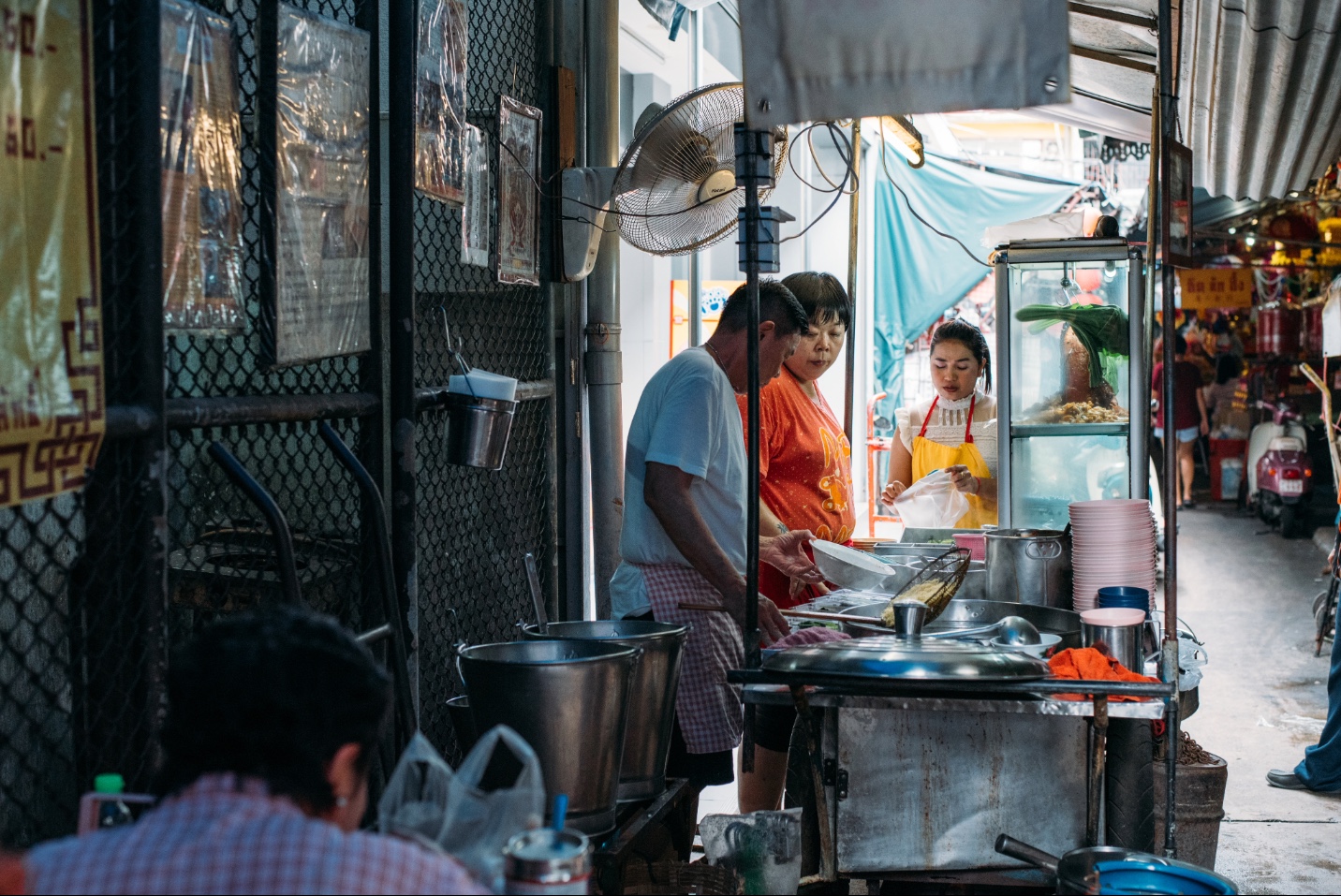
Bangkok culinary landscape is probably among the most complex and diverse in the world
THE THAI CONSERVATIVE VIEW ON THAI FOOD
For Thailand, food is more than just food. It creates national identity, pride and unity. Conservatives deem food to be rooted in the most sacred essence of Thai national identity, which is? Did you guess? Nope, not mango sticky rice. It’s the monarchy. Thailand’s famous dishes, many of which hail from Thailand’s central region, carry a flavor of political ideology as they’re linked to royal Thai cuisine and to traditional Thai food as we know it today. The seat of the Thai monarchy is located in the heart of Bangkok, capital of the world’s largest Theravada Buddhist country. The Royal Palace and the culture therein are the paragon of Thai or Siamese high culture which elevated Thai food to the complex, refined and balanced cuisine it is today. It’s in the inscriptions and poems where food and certain dishes are first mentioned by kings and later codified in royal cookbooks. The royal kitchens of the palaces were the engines of Thai culinary development because of diplomacy, trade relations and the access to exclusive and rare ingredients, methods and technologies which were unavailable to the rest of the population. Refinement and adaptation of foreign and regional culinary influences happened under the highly trained and skilled guidance of the female members of Siamese aristocracy but high-class food remained the domain of the elites until the abolition of the absolute monarchy in 1932.
EARLY THAI FOOD CULTURE
Thailand’s first kingdom Sukhothai (1238-1438) mentioned fruits and vegetables in stone inscriptions. By the 17th century the kingdom of Ayutthaya developed into the region’s largest and most cosmopolitan city with diplomatic ties from China to Persia and a culinary culture that reached a level of formality shaped by Khmer court culture. Food culture during that period as recorded by foreign envoys was cooked by foreign chefs and included Indian, Persian and Chinese dishes. Curries such as massaman, Portuguese desserts made from egg yolk and sugar, Chinese steamed dishes and other delicacies showed two things about early Thai food culture: first it was multi-cultural and second it was class based. Foreign dishes can be referred to as guest food and were inaccessible to commoners. Commoners consumed the indigenous food described as a paste of a pungent and “rotten” (fermented) paste made from fish, rice and fish. Arrival of ingredients from the New World via the Iberian and Portuguese trade in the 16th century included papaya, chilli, pineapple, sweet potatoes, cassava, tomato, corn among others. Salt production from the sea was introduced in the Ayutthayan period, using sugar besides the native use of palm or coconut sugar, Persian spices, curry making techniques and using coconut milk were already established and provided the foundation for the royal Thai cuisine of early Bangkok. Chinese stir frying expanded and became more widespread by the influx of Teochew Chinese during the Thonburi period (1767-1782) and even by the later half of the 19th century, the food culture of Bangkok remained very similar to that of Ayutthaya.
CENTRAL THAI – A CUISINE OF CLASSES?
Historically you can divide Thai food into highclass food, e.g. food cooked at the palace for the royal family and nobility and the food of the Thai commoners rooted in what was locally available. Since the food of the commoners was something the royal family relished as well you could divide royal Thai food into two types: The first type would be the same diet as the commoners: rice, fish, vegetables and chili relishes or chili dips with a type of fermented protein but it would be prepared with premium ingredients and other principles of Thai royal cooking to arrive at a more refined result. The second type of royal Thai food was made from expensive ingredients and cooking methods which arrived through trade from far away regions and were largely inaccessible to Thai commoners.
Commoner food
THE BASIC BUILDING BLOCKS OF THAI FOOD
Though Thai culinary culture at the royal court kept evolving, especially in the late 19th century, the diet of ordinary farmers remained the same. The diet was based on what the environment provided. Thailand’s fertile central plain is characterized by rivers and thousands of canals. Fresh water fish was abundant, especially during the rainy season when the central regions flooded over several months. Thais were experts in preparing fish in all manners and it was their main protein source (not pork or chicken). During the early Bangkok period the central plains were sparsely populated with subsistence farming communities dotted across the river basins and a few minor towns near rivers and the coast. Fresh herbs, aromatics, roots and citruses such as galangal, lemongrass, shallots, chili, garlic, coriander, wild ginger, kaffir lime, etc. were available and combined with a fermented protein such as kapi (shrimp paste) it is DNA of the most essential building block of Thai food which is the paste. Thai culinary tradition uses fresh herbs instead of dried spices which is common in other cultures. Regardless of social class as these key ingredients are pounded into a paste with pestle and mortar and build the foundation for curries, marinates and the most Thai element of Thai cooking: namprik (chili relishes or dips). You can find namprik at freshmarkets in Bangkok and combined with rice, vegetables and fish they constitute the basic meal for Thai commoners. The paste or namprik is the part that gives the meal its zest and taste. Farmers also had access to lots of fruits, coconuts and vegetables both cultivated and in the wild.
My mother’s been in Germany for 47 years and just as the French wrote in their diary about the Siamese frugal lifestyle of fish, rice and “a fermented paste similar to mustard” so was my mom happiest with a zesty namprik, fish and some rice. As a kid I stayed clear of namprik for its pungent smell and spiciness but fast forward into the future, the Covid pandemic forced as a more frugal lifestyle and my mother in law prepared a range of regional versions nam priks such as Namprik Ong – a northern tomato and minced pork based relish or namprik makham, the sweet and sour tamarind based namprik. I fell in love with namprik, which goes well not only with vegetables but with grilled meat, sticky rice or nicely baked omelette. My curiosity has been sparked and it’s worth dedicating an entire section on our website as a tribute to namprik, especially since this category of Thai food is probably among the least explored by foreigners.
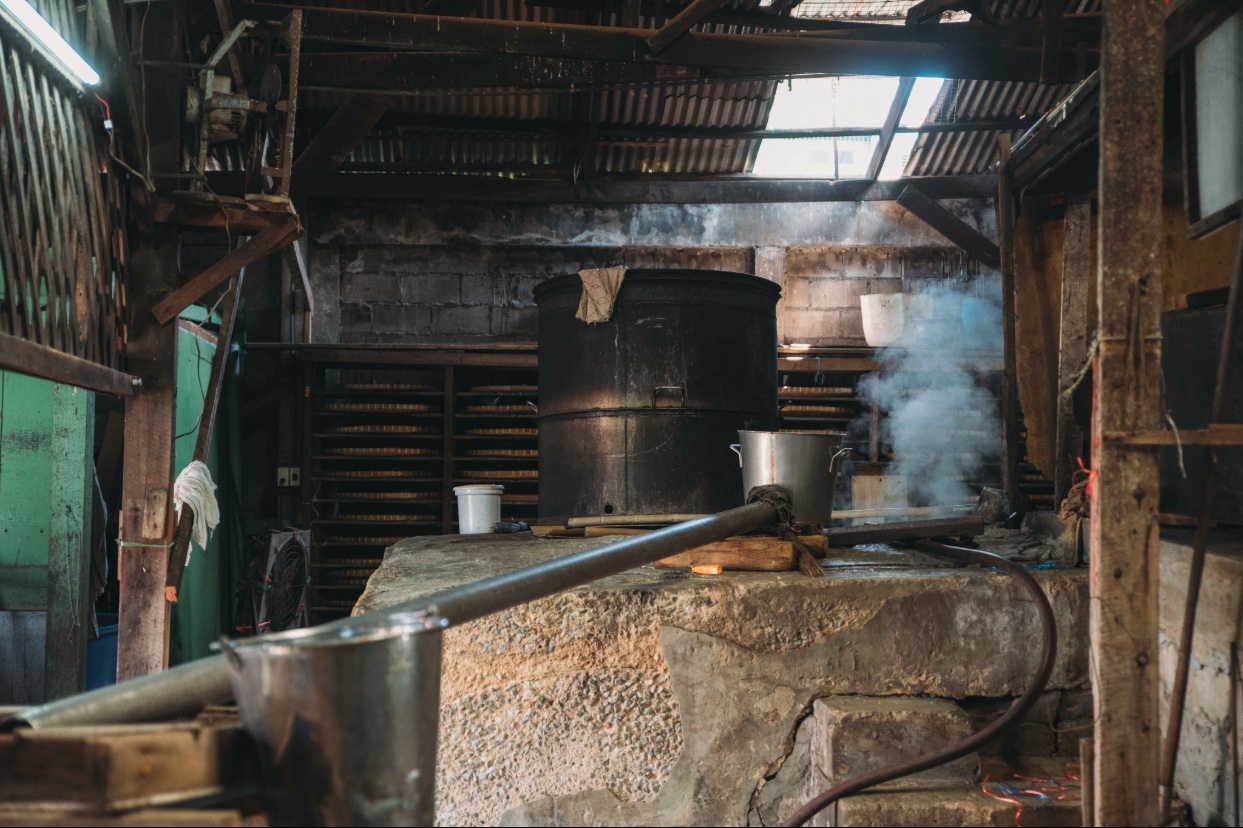
Shrine of King Taksin of Thonburi. He wasn’t know to be a food and not much is known about the culinary development during his reign
THONBURI PERIOD
After the destruction of Ayutthaya in 1767 many survivors fled down the Chao Phraya river to the areas around Wat Arun and today’s Grand Palace. The area became the gathering grounds for war refugees, traders, slaves and surviving nobility and was consolidated during the Thonburi period (1767-1782) which also saw a large influx of Teochew Chinese. Following the founding of Bangkok in 1782 Bangkok consolidated and expanded its power it turned other political centers such as Lanna (Chiang Mai), Luang Prabang, Cambodia and Malay Sultanates into tributary states and relocated entire populations from those regions to the heartland of Siam to prop up its population. Both indigenous and the early outsider groups including Mon, Cham Muslims, Vietnamese, Malay, Portuguese, Teochew Chinese, etc. sprung up along the river and canals and built their communities, their mosques and churches. The Portuguese brought us the first things that you baked in an oven such as kanom Farang, a Portuguese cupcake made from flour, duck egg and sugar. A sweet delicacy that can be found across the city but made by only three families in Thonburi’s Santa Cruz community who still bake the way it was done 500 years ago. In the same community you will find traces of the ancient Mon people who are known for one of Bangkok’s most popular noodles, the fermented rice noodle dish: Kanom Chin which is eaten with different curries and a side plate of fresh herbs. Sit in an old home by the river and enjoy kanom chin with an incredibly delicious chicken curry and you’ll thank me later.
In the decades following Bangkok’s founding more ethnic groups arrived. They did not come voluntarily but were taken from the peripheral tribute states and resettled in the central plains to increase an inherent low population density and prop up a population ravaged by war. These groups consisted of Malay Muslim, Sham Muslims, Cambodians, Laotians, Vietnamese refugees, etc. who joined in the patchwork of pre-existing communities of Mon, Teochew and Hokkien Chinese, Portuguese descendants, etc. They did not come to trade, they did not bring supply chains or ingredients but only knowledge of cooking methods and their everyday food assimilated into a central Thai food diet, switching from consuming sticky rice to non-glutenous rice. They kept some of their ritual food offerings but they did not build a visible food presence and their diet became that of the Siamese commoner. This would change with the modernization of Siam in the late 19th. century as migration increased from diverse regions through trade or employment. With them came an entire system of logistics that allowed for diverse food culture to become visible and eventually part of Thailand everyday food.
The golden age of Thai cuisine
CULINARY INNOVATION OF THE LATE 19TH CENTURY
With the dawn of free trade and Siam’s role to supply Britains colonial markets in the second half of the 19th century under King Chulalongkorn (Rama V 1868 – 1910) Siam’s economy began to scale significantly and was accompanied with sweeping economic and social reforms that gradually transformed Bangkok from a waterborne city to a landbased city. Opening up trade and diplomatic ties with the British and other European powers set in motion the flow of technologies, ingredients and people from the realms of western empires, especially British Straits, Indonesia into Siam and especially Bangkok. King Chulalongkorn was a foodie himself with great interest in European culture. He integrated western aspects of culinary etiquette such as usage of fork and spoon, codification of Royal Recipes in the landmark cookbook Mae Krua Hua Pa in 1901 by Lady Plian Pasakornrawong which standardized traditional and hybrid Siamese recipes, reflecting a fusion of local wisdom and multi-ethnic regional/foreign ingredients. Cooking in the kitchens of the palace has always been a multi-cultural affair but it reached new heights during Chulalongkorn’s reign. New products and technologies such as refrigeration, European-style canned goods, dairy products, flour, European vegetables, and western condiments found their way into the kitchens of the palace. At the same time old dishes recipes were revived and popularized.
There are many iconic dishes of Chulalongkorn’s reign, some are widely available such as khao kluk kapi, miang kam, massaman and tom yum while others are available in the less common restaurants that uphold a strong identity with royal cuisine such as mee krob or som tam khao man. What made the fusion of foreign, regional and indigenous cooking Thai royal cooking is the notion of ros klom – a round flavor where the food must balance sweet, sour, salty and bitter and ought not to be too spicy or overpowering. Every flavor is present without dominating the others. The word sweet is also used to describe royal Thai cooking but what is meant is rather the relative absence of bitter or spicy. Royal Thai food is also formal, serving and presentation of food is done in accordance with the status of those being served. Food is served through an assortment of complementing dishes which we call a samrab which is the way we eat when we go out with friends.
REGIONAL THAI FOOD AT THE COURT
Another important factor that contributed to the diversity and complexity in central Thai cooking was the political integration of tributary states into Siam. The northern kingdom of Lanna and the autonomous regions of the south were integrated through marriages between King Chulalongkorn and the daughters of the regional aristocracy. As these princesses moved to the palace in Bangkok they brought many regional recipes which were adapted and became popular in central Thailand. Siamese food culture however remained within the domain of the elites and new royal culinary innovations and variations were served to the Siamese highclass given as offerings at merit making ceremonies and served in banquets and receptions to foreign envoys and dignitaries.
The mother of all combos – the samrab
If I’d go out for Thai dinner with my friends in Germany, half of them would order Phad Thai and the other half would go for a massaman curry. That’s a missed opportunity. Instead, you should order six or seven different dishes and you can claim ownership only for your plate of rice, the rest is placed in the middle of the table to be shared. This is a samrab, the selection of dishes which reflect the different categories or classifications of Thai food. It’s your opportunity to try new things, to mix and match and create new flavor experiences with each bite. The massaman curry would represent a coconut milk based curry while the other dishes include different flavor profiles, proteins and cooking methods. A samrub should include the following building blocks of a Thai meal: A soup (tom), curry (gaeng), Thai salad (yum), a stir fried vegetable and/or meat (phad), a relish (nam prik) and additionally a type of meat either grilled or deep fried with a dipping sauce. The dishes should be balanced and complement each other and are shared and combined at will. So, next time you eat Thai, don’t do it the individual western way, do it the Thai way and let us introduce you to those build blocks of flavors explosions.
The Chinese dimension
With the economic and other reforms of Siam’s during King Rama V’s reign Bangkok’s urban society became more diverse and cosmopolitan and the city’s food scape evolved alongside it. Besides migration from the British controlled territories e.g. Malaysia and India, the predominant source of labor came from the coastal provinces of China. These migrant groups stayed concentrated within Bangkok, selling food first to each other then to anyone else. The Chinese population made up the largest chunk of non-Thais in the capital. Some sources put the figure at three quarters of Bangkok’s population being minorities of which more than half were Chinese ethnicities. As with Siamese society, the Chinese presented two classes – an impoverished worker class and an early bourgeois class driven by merchants, tax farmers and wealthy tycoons. Bangkok’s culinary landscape thus changed two-fold. On one hand you had a growing demand to feed the army of labor leading to the profileration of rice based quick and affordable meals for urban workers and were the precursor for some of Bangkok’s most ubiquitous pork dishes: Khao moo daeng, red bbq pork with rice, a dish that I ate a lot as a child when visiting Thailand. Unlike the Siamese peasants’ diet of fish, the Chinese street food culture centered predominantly around pork, duck or chicken. Slaughter houses have been firmly in Chinese hands and duck-, chicken and pork-based dishes and ingredients such as sprouts, kale, pickled and fermented food like pickled garlic, cabbage, century eggs, fish sauce, vinegar, soy sauce, noodles, soups, dumplings, buns, fried donuts, porridge and the list goes on became widely used and sold and are staples in today’s culinary landscape. The profound impact on Thai cooking includes cooking methods such as stir frying which became an indispensable part of central Thai cuisine and a symbol of Bangkok’s street food culture.
BANGKOK’S FIRST RESTAURANTS
The diversification and elevation of urban food culture was also driven by Bangkok’s growing bourgeois and wealthy merchant class. Bangkok’s economic reforms and modernization saw commerce shifting from water to land and neighborhoods evolving through road construction and electric tram lines as more and more foreign businesses kept setting up shops. Combined with Asia’s business world meeting their business partners in Bangkok, the demand for hotels, high-level Chinese cuisine began to grow and Bangkok’s first restaurants appeared on the scene. Among Siamese elites however, eating outside your home or palace was seen as something done only by the poor and downtrodden. Eating at a market was compared to the existence of a dog. As restaurants and hotels became places for the ‘who is who’ of the business world, the attitude of the Siamese aristocracy changed. Business tycoons and nobility mingled in the new culinary and entertainment strips along Charoeng Krung Rd., Yaowarat and Surawong Road. These places became the hubs for Chinese high-cuisine. High quality fish, steaming and priced items such as birds’ nests, shark fin, etc. became a status symbol and legendary places served it to dignitaries such as Deng Xiaopeng and others.
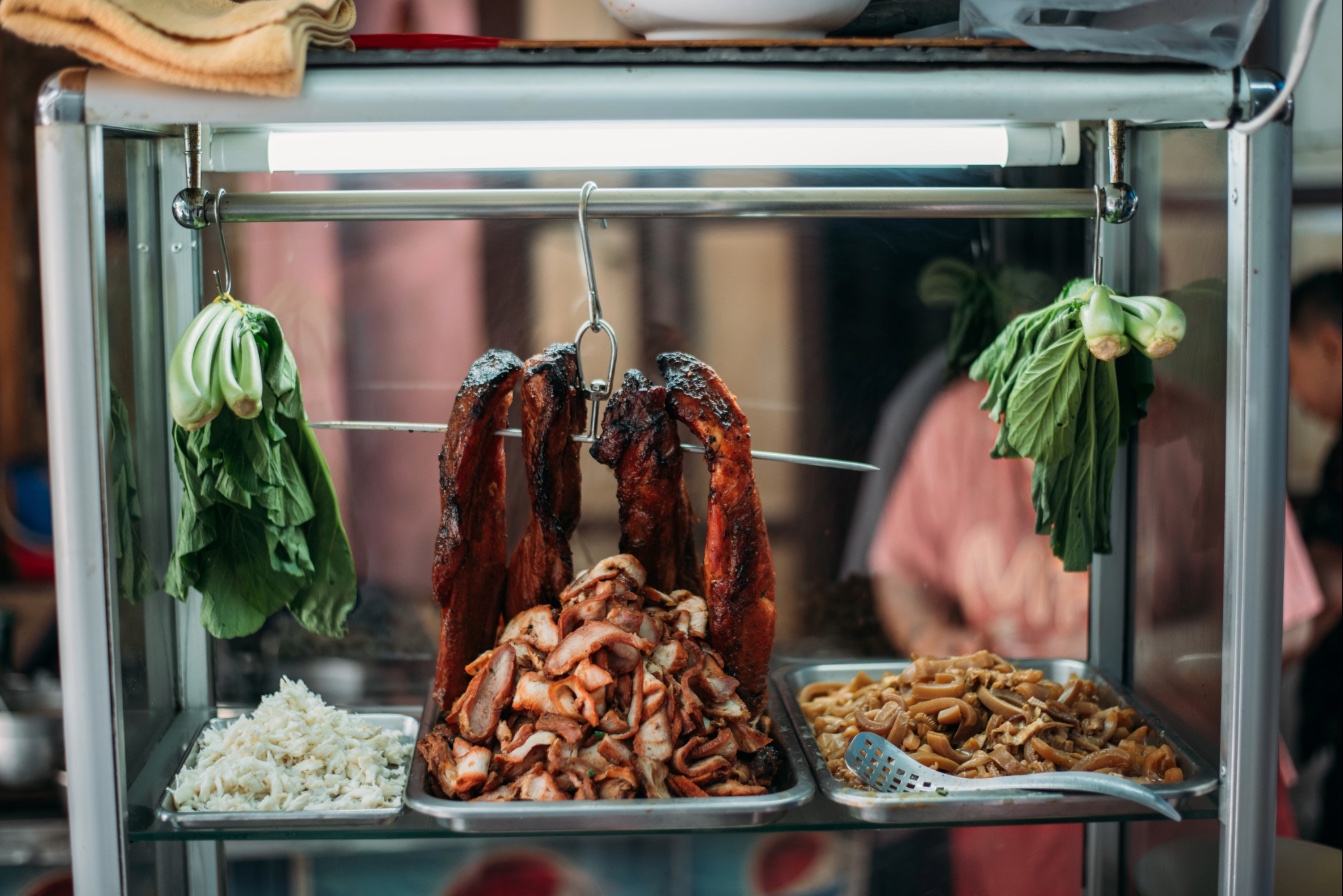
Cantonese bbq pork
NOT ALL BUNS ARE THE SAME – ETHNIC CHINESE CULINARY DIVERSITY
Some people hear the word Chinese and think of it as a homogenous entity but that’s not true at all. While there are numerically dominant groups such as the Han Chinese, Thailand’s Chinese diaspora represents different Chinese ethnic groups such as Teochew, Hokkien, Cantonese, Hailamese and Hakka. Each of which arrived in Siam at different historic periods and from different regions. Each group is also referred to as dialect groups. They hold their own identities, histories, traditions and culinary cultures. A baoze (steamed bun) prepared by the Teochew is different than the ones made by the Cantonese. The same goes for their noodles and preferred ingredients. A journey through Bangkok’s Chinatown and street food scene is a journey through China’s plural histories. Teochew’s Palo stews, braised pork leg, oyster omelette, Cantonese char siu, roasted duck and goose as well as dim sum or Thailand’s most popular chicken dish – Hainanese chicken brought to you by the people the Hailamese whose chicken dish conquered Singapore first. The Hailamese are also known to have been at the helm of western kitchens in hotels and wealthy homes. Eventually they established their own restaurants locally referred to as cook shops. These were the first restaurants serving western food in the 1930s and became the trendiest dining style after World War 2. Today they are disappearing from the culinary scene and visiting one feels like a true time bubble where you can enjoy western influenced comfort food such as oxtongue stew as well as Thai-Chinese fusions.
The culinary world of Indian Ocean trade
FLAVORS OF THE SOUTHERN REALM
Siam sits right at the intersection of the Chinese and the Indian civilization. Both shaped Siam’s polity, economy and cuisine and the period of King Rama V, especially around the turn of the 20th century is a great example of this. As Siam’s economy was built by the Chinese it connected Bangkok’s food culture to the coastal provinces of Southeastern China. The British on other hand were in full swing to embed Siam into the colonial markets of the Indian Ocean and beyond. With free trade in Siam and a British presence in Singapore, Indians, Tamils, Malay, Sikhs, Javanese, Strait Chinese, began migrating to Bangkok. They came to trade or were hired, whatever the case may be, they brought know-how, ingredients, networks, recipes and cooking methods to bring the flavors of the southern world of Indian Ocean trade to Bangkok. Surely Persian spice traditions and Massaman were already documented in the 17th century, but as King Rama V travelled the world he had a keen interest in food as well. During his reign you saw ancient dishes like Massaman rejuvenated, he brought in the Javanese to create the gardens of the royal palace but what’s even better is that they created the beginning of Satay skewers in Siam. Satay like roti and other common and beloved flavors of Bangkok’s markets and restaurants had their genesis in the Indian and Arab spheres, travelled to southeast Asia centuries ago, evolved and were renamed and through British controlled trade finally made it to Bangkok via Javanese and Tamil migration. That’s the beauty of food, it does not need a visa, it arrives, it fuses, evolves and enriches the culinary spectrum of society. The food that travelled from the Indian, Arab and Persian domain via maritime Southeast Asia have one thing in common, they are part of Bangkok’s restaurants and food carts operated by the Thai Muslim community. While pork and poultry farming was in Chinese hands, cattle farming and beef production also became the domain of Bangkok’s Muslim population. Thailand is home to a large Halal industry which means, their culinary influence does not contain pork, instead many dishes feature beef and chicken. That’s why you won’t find pork in massaman or khao soi (being a Muslim influenced dish from southern China).
The second most popular chicken dish in Bangkok after khao man gai (Hainanese chicken) is most likely khao mok gai. Khao mok is a brilliant Thai Muslim version of Biryani. Khao mok means buried under rice referring to a cooking method where meat is slowly cooked in seasoned rice. The cooked meat is then served with khao mok – steamed rice, golden in color through the use of turmeric and localized versions have punchy curry-like spice profile. More refined versions boast a delicate, complex, and herbal blend of whole spices featuring cardamom, cloves, cinnamon, and sometimes saffron or mint. It’s among the culinary hall mark dishes in the markets of Bangkok and to unbury that chicken or beef from the golden biryani is one of my favorite pursuits during lunch time.
Other Muslim stars that came, cooked and conquered aside from Satay and khao mok is a wheat based delicacy that prevailed in the kingdom of rice – Roti! It became so popular that you’ll find five carts on a stretch of 200 meters along Rambuttri Road. But forget Khaosan or Rambuttri, it’s good but there are more versions how to eat it outside banana + nutella (which is great too) but try na num the thicker, outside crispy, inside soft version with classic sweetened milk or savory eaten with curry or stuffed with meat and vegetables.
1932 – ROYAL THAI FOOD FOR ALL
The authority of refined royal Thai cooking remained in the spheres of nobility and royalty until the end of the absolute monarchy in 1932. The culinary knowledge of the court leaked into the wider elites and middle class through schools, cook books and the expansion of mass media such as radio and later TV. The definition of cooking of Thai food became the domain of the state, especially doing the nationalist nation building project in the 1940’s and later through the markets. Thailand’s first home science school opened in 1934 and taught for the first time culinary arts to middle class women instead of aristocratic households and Thailand’s radio shows and broadcaster spreading and adapting royal recipes for mainstream society to be adapted and redefined.
1930 – 1940 REVOLUTION OF THE DIET – THAI FOOD FOR A STRONG NATION
Thailand’s traditional institutions have long played a role in defining Thai food. From 1932 it was now the state’s turn to define what is good food and it created a significant legacy of Thai food consumption and culture. The 1932 Revolution was the dawn of Thailand’s food revolution. Under the new political system, the state focused nation building, modernization and ultra-nationalism under Fieldmarshal Phibun (1938-1944 and 1948-1957). To build a strong nation and national prosperity you needed strong people. It was no longer about the number of people as in the early days of Bangkok but the quality of people. Thailand in the mid-twentieth century was rich in natural resources but still very much impoverished and the food culture and the resulting healthcare issues were proof of that.
Thai people traditionally did not like to consume meat from large animals, partly due to Buddhist beliefs, abstaining from killing large animals, such as pigs and cattle. Monsieur de Grean, a Frenchman appointed as the Thai Consul in Paris in 1863, stated that the Siamese people eat very simply and very little meat. Their regular food is rice porridge and fish, young bamboo shoots, and other vegetables, which are usually eaten with red chili paste. Thai home-cooked meals did not emphasize meat, which provides much protein. Dried fish, the most common ingredient used as a small side dish to go with rice. It meant a lot of rice but little nutrients. That’s the same food culture my 99 year old grandmother grew up with. They were told to eat a lot of rice but little side dishes. “Eating a lot of side dishes makes you become a thief.” To tackle the nutrient deficiency of the ancient food culture the new slogan became “Eat a lot of side dishes, eat just enough rice.” The imbalance in the diet of ordinary people created devastating healthcare issues which stood in the way to build a strong and wealthy nation. The data showed that a century ago the life expectancy of ordinary Thais in Bangkok didn’t even reach 40 years. Infant and young child mortality was 34.5%. Nearly 30% of the population died from malnutrition-related diseases, such as jaundice, blindness, and anemia. These terrible conditions called for comprehensive efforts by the government to turn the tables. The importance of the cultural mandates (ratthaniyom 1939-1942) that are often mentioned for example how Thais should dress and behave or civilized practices such as eating with spoon and fork were dwarfed by the urgency of saving lives.
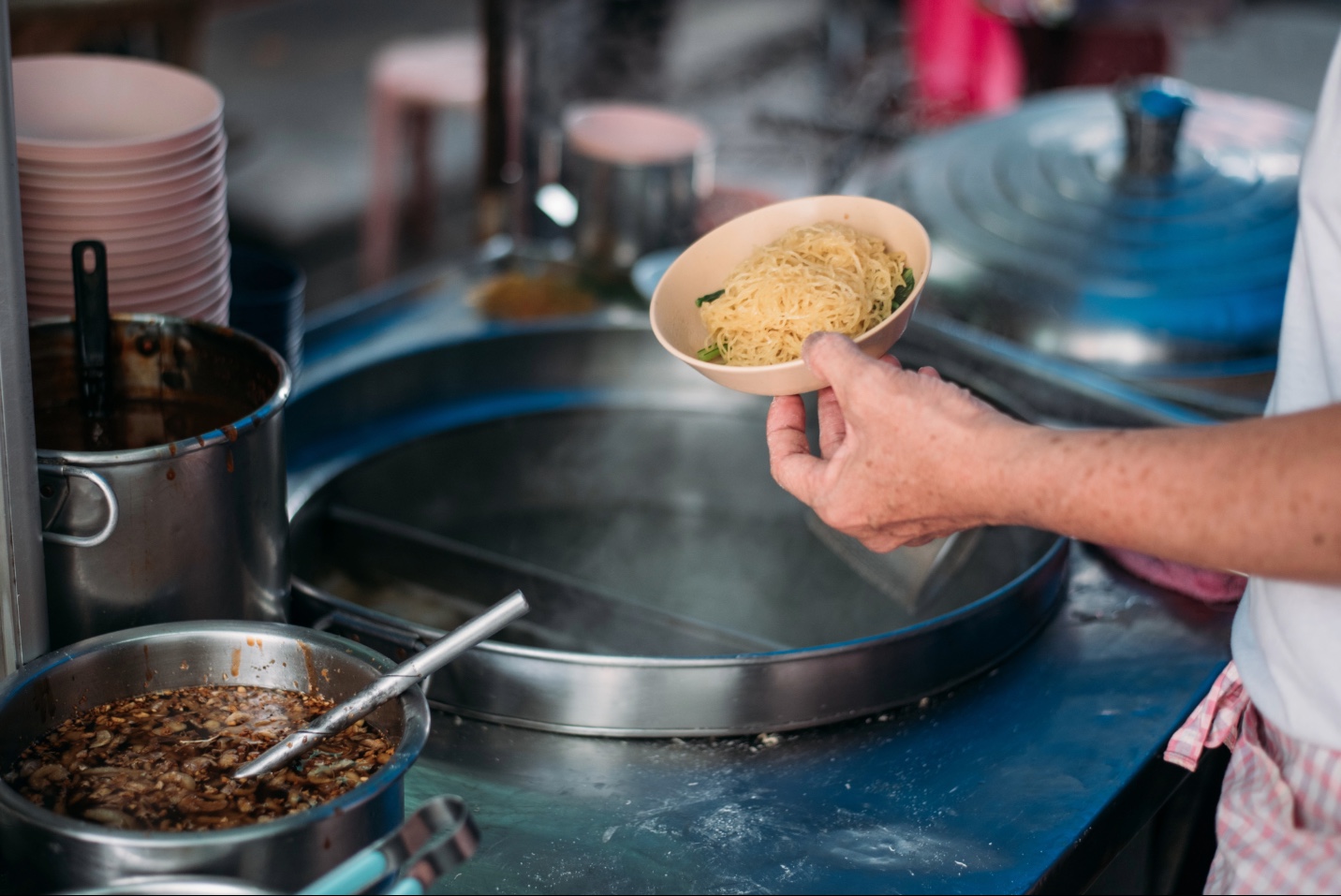
Noodles for the people
When Siam changed its name to Thailand it was the goal to build a strong nation but faced with the reality that the health condition of the population was devastating. The post-revolution policy was to revolutionize the diet of its citizens and prevent them from becoming unhealthy, small, and short-lived as they once were. In 1934 the new nutrition initiative began which meant the expansion of medicine and public health, creating institutions and health knowledge centers which exerted profound influence on the daily lives of Thais.
This dietary revolution did not focus on luxurious and expensive dishes as in the past and it rejected the eating for survival of the lower classes. “The Thai state emphasized on nutritious food that was essential for building strong Thai citizens and for the nation to progress. The idea of ideal consumption and the ideal body to create a new generation of citizens was born. From the late 1930s to the 1940s scientific knowledge about consumption was shared to the public through articles, textbooks, and modern communication channels such as radio stations. The key phrase, of the revolution of nutrition and diet, was “Eat a lot of side dishes, not too spicy and eat just the right amount of rice.” Consumption aligned with the principles of consumer science requires “reducing” or eliminating the spiciness and saltiness of the food. The new nutritional concept to create a quality population changed perceptions of healthy food which should contain meat to increase protein. Villagers were encouraged to add eggs, meat, fish, fresh vegetables, and very ripe fruits to reduce the spiciness to their diet.
A Household food production policy was enacted, the Kitchen, Gardening and Livestock Raising Act of 1939 to promote household food production. Civil servants in both central and regional governments were ordered to cultivate kitchen gardens and raise livestock as well as fish breeding as examples for the public and to distribute the breed to the general public. The government established inexpensive restaurants, and opened fresh markets to promote affordable products and serve as trading centers for the vegetables the government encouraged every household to grow. This Thai public health and nutrition campaign resulted in the most significant revolution in the eating and living conditions of Thai people.
The government urged the public to cultivate more vegetables and recommended Chinese cabbage, kale, pumpkin, winter melon, cucumber, and eggplant. The government also encouraged the public to raise frogs, eels, snails, rabbits, and pigeons and promoted chicken and duck egg production. Additionally the government published a handbook on simple ways to find food and produce sufficiently for every household. These included methods for cultivating a kitchen garden, making shrimp paste, fish sauce, and pickling vegetables for long-term storage. Also, Thais can find ingredients all year long and most vegetables are cultivated. Not too long ago many vegetables were gathered along the many rivers and canals that meander through the region. The people here often refer to their vegetables in two categories, water or land vegetables, depending on where they are grown. Water vegetables include the ubiquitous Siamese watercress, used in sour yellow curries and stir fries, lotus shoots which can be simmered in coconut cream with small mackerel or water mimosa which comes stir fried, simmered in curries or served as a sour, spicy salad. Land vegetables such as the fern-like cha-om, appear in omelets and there are many varieties of eggplants and several types of bamboo shoots which are sliced and either boiled or fermented for soups and curries, or stir-fried.
The noodle era
PAD THAI LEGENDS
Just as Siam was renamed Thailand on June 23rd, 1939 the Pad Thai narrative fits right into the popular belief of nationalism being the key agent for the invention of Pad Thai. The popular history of “Pad Thai,” says Pad Thai was the idea of Field Marshal Piboon Songkhram’s to create a distinct dish that represents unified Thai identity and aligns with the nationalist policy of modernization and unification. Another idea states that the noodle consumption policy was induldged by the leader after eating noodles served at Government House. This was during the great flood of 1942. He became so fond of noodles that he wanted to encourage people to eat and sell noodles. He believed that noodle consumption would help mitigate severe rice shortage caused by the flood and create jobs for Thai people in an area dominated by the Chinese.
However the birth of Pad Thai can actually be tied to the government’s push for the new nutritional policy to build strong citizens which included the food cultivation promotion. In an interview his own daughter Jiravat Panyarachun states that Pad Thai was her father Field Marshal Plaek Phibunsongkhram’s or her family’s idea. Pad Thai has been around and eaten by members of the royal family for a long time. She found it incredibly delicious and she’s been eating it since she was a child. But the story of the noodles is true. Her father pursued a policy of economic nationalism and wanted Thais to sell noodles because only Chinese were there to sell them. This nationalist policy was carried out hand in hand with other legislations such as reserving specific occupations for Thai nationals only and creating Thai controlled state enterprises.
Much points to Pad Thai being part of the government’s policy to develop appropriate recipes and recommend them to the public for health benefits. Noodles are readily available locally, easy to prepare, quick, convenient, and inexpensive. Despite being the food of working-class Chinese, noodles were extremely beneficial and besides creating jobs they could be integrated into many of the government’s existing activities, including vegetable farming, animal husbandry and trade of mixed goods. In late 1942, noodles were considered an important topic and frequent campaigns on the radio encouraged Thais to eat noodles, even playing a noodle song urging everyone to consume for national progress. Noodles also represented the food of the new era under a new regime. The campaign was successful although it took time for this shift to spread through society but that shift towards noodle consumption is more than just Pad Thai. Today Bangkok offers a mind-boggling scope of noodle dishes, rice noodle soups such as Guay Tiaw, with gravy (rad na), stir-fried with soy sauce (pad si ew), or rolled (guay jab), Hokkien style (mee sua), Hakka noodles (Guay Tiaw Kae) or Hainanese noodles (Kanom Jeen Hai Lam) or Cantonese (bami) which are among the most commonly eaten dishes, not including the range of highly popular instant noodles, Japanese, Korea, added later to the city’s foodscape.
1950 – 1970s AMERICANIZATION AND THE RIDE OF FOOD MASS PRODUCTION AND CONSUMERISM
It’s impossible to compress the complexity of more than half a century of domestic politics linked to geo-politics and socio-, economic developments and their impact on food into a few paragraphs. To keep it short I will only crudely summarize but leave this as a major project to elaborate in future articles.
After Phibun’s nationalist government stepped back three forces took over: development, industry and the market. If the 1940s were about defining what is good and nutritious Thai food, the decades from 1950 to 2000 were about mass-producing it, moving it onto the street and eventually exporting it. Food culture wasn’t shaped by tradition anylonger. It was shaped by a system created during the cold war era which meant U.S. aid and infrastructure development, economic influence, security and scientific collaboration in exchange for military bases, private sector growth and an alley in the fight against communism.
THE RISE OF AGRIBUSINESSES
The roads, highways and dams built by American aid were not just counter insurgency but opened up and irrigated new farmland for rice, cassava and maize. Scientific research and collaboration between CP group and U.S. breeding giants such as Aberacres (a Rockefeller company) led CP to become one of the world’s largest chicken meat producers. CP organized contract farming and vertical integration, controlling everything from feed to breeding stock to processing. Chicken went from a festive meat to a cheap and mass produced protein underpinning our daily servings of stir fries, hainanese chicken, grilled chicken, KFC and more. It was the agricultural arm of the Americanization process of the free world and it marked a turning point in the global food production system. With new technology, food became industrially produced, while agriculture was transformed into a large-scale “plantation” system with positive and negative effects. Increased food production, greater certainty, and clear control vs. reduced variety of food and keeping control of the food chain in a few hands of large Thai-Chinese agribusinesses. Agrochemicals, seeds and fertilizer were sold through the same networks. It was a win-win not only between Thailand’s military leadership and the U.S. but also between the Thai-Chinese business elites and the military led government which provided them with licenses, concessions, protection, monopolies and labor control. It was the birth of a Thai autocracy which was a marriage between militarist-, royalist political establishment and Sino-Thai oligarchy which allowed a small group of Thai-Chinese family conglomerates to become the dominant core of Thailand’s economic elites. This structure of who produced and controlled what for whom and who benefitted from that merits its own examination as it still holds strong undercurrents of exploitation, issues of human rights and labor rights, inequality, injustice and environmental degradation that are part of the political and socio-, economic realities of Thailand.
In the 1960s Thailand had all the pre-conditions to shift into an agricultural hyperdrive as it was still a plantation economy with roughly 84% of its population being farmers. It was also the decade when Khao Hom Mali jasmine rice came to define “Thai rice” worldwide. I see the 1960’s as the last traditional decade, a decade where waterways were still relied on for transport and trade but were rapidly filled in to make way for roads under the new National Economic Development Plans. It’s the decade where plastic replaced banana leafs for packaging and became a revolution for convenience, from being used for take-home food in plastic bags to bagged iced coffee and coke. It was the decade when traditional flavors of pastes and fermentation were supplemented by industrial flavors such as MSG, bottled sauces and the introduction of Mama instant noodles in 1972 completed Piboon’s noodle takeover in the kitchen shelves. Milk consumption made inroads in a country with no dairy tradition and royal projects in the north promoted vegetables, strawberries and coffee as substitutes for opium. In the following decades Thailand rose to 4th place as the world’s largest sugar producer and average annual sugar consumption per person in Thailand went from 4.3kg in 1958 to 42.3kg in 2021. Food vending moved from boats to the pavements and shophouses. The proliferation of postmodern shophouses became a defining physical characteristic of Bangkok’s rapidly and densely urbanizing environs and a symbol of the era of Americanization. Besides the street food carts occupying the sidewalks, the countless open front restaurants occupying the ground floors of those shophouses became the backbone of urban dining in Bangkok. The best of those kitchens and stalls received their first accreditation of a restaurant guide called Shell Chuan Chim by food writer M.L. Thanadsri Svasti roughly 60 years before the Michelin Guide made its debut.
1970 – 1990 Isan migration
THE PROLIFERATION OF STREET FOOD
Thailand’s first highway, the Mittraphab Road or Friendship Highway, opened in 1958 and was built by U.S. aid to supply U.S. military bases. It connected central Thailand with the Isarn region and made cross-regional travel more convenient. The Isarn region was to become the primary source for human labor to fuel the shift from an agrarian economy to an industrialized one. From 1960 to 1980 Bangkok’s population doubled from 2 to roughly 4 million people but that was only the beginning. U.S. military presence and investments during the Vietnam war in the 1970’s created a lot of jobs and modernized Bangkok’s new emerging Central Business District around Silom, Sukhumvit and Phetburi Roads as Bangkok. Bangkok became the hub for thousands of U.S. soldiers on R&R. It brought a wave of new hotels, western style eateries, American steakhouses, bakeries and bars which last but not least Bangkok its notorious reputation for night life and prostitution.
In the farms and rural communities of Thailand, young people packed their bags and left for Bangkok in search of opportunity. Not only in Isarn but all over Thailand, Bangkok was calling. My mother left the coconut farm in Samut Songkhram when she was 18 years old in 1974, took the bus to Bangkok in search of work. She found a job as a kitchen helper in a restaurant in Sukhumvit run by an African American and it was there, when a waiter fell ill and my mom was sent from the kitchen to help that she met my German dad. Without that American presence, I would probably not be here today.
From the 1980’s migration to Bangkok picked up, the plaza accord accelerated Thailand’s industrialization process as Japan moved its car and electronics manufacturing to Bangkok’s new industrial belts. Thailand’s economic boom drew millions of people from all parts of Thailand to Bangkok and the population grew from 4 million in the 1980’s to an estimated 10 million by the late 1990s. Migrant workers from Isarn made up the vast majority of that migration. The city’s working class food culture, once characterized by Chinese staples, was supplemented by sticky rice, papaya salads, larb and other delicacies from Isarn and the world of the Mekhong region.
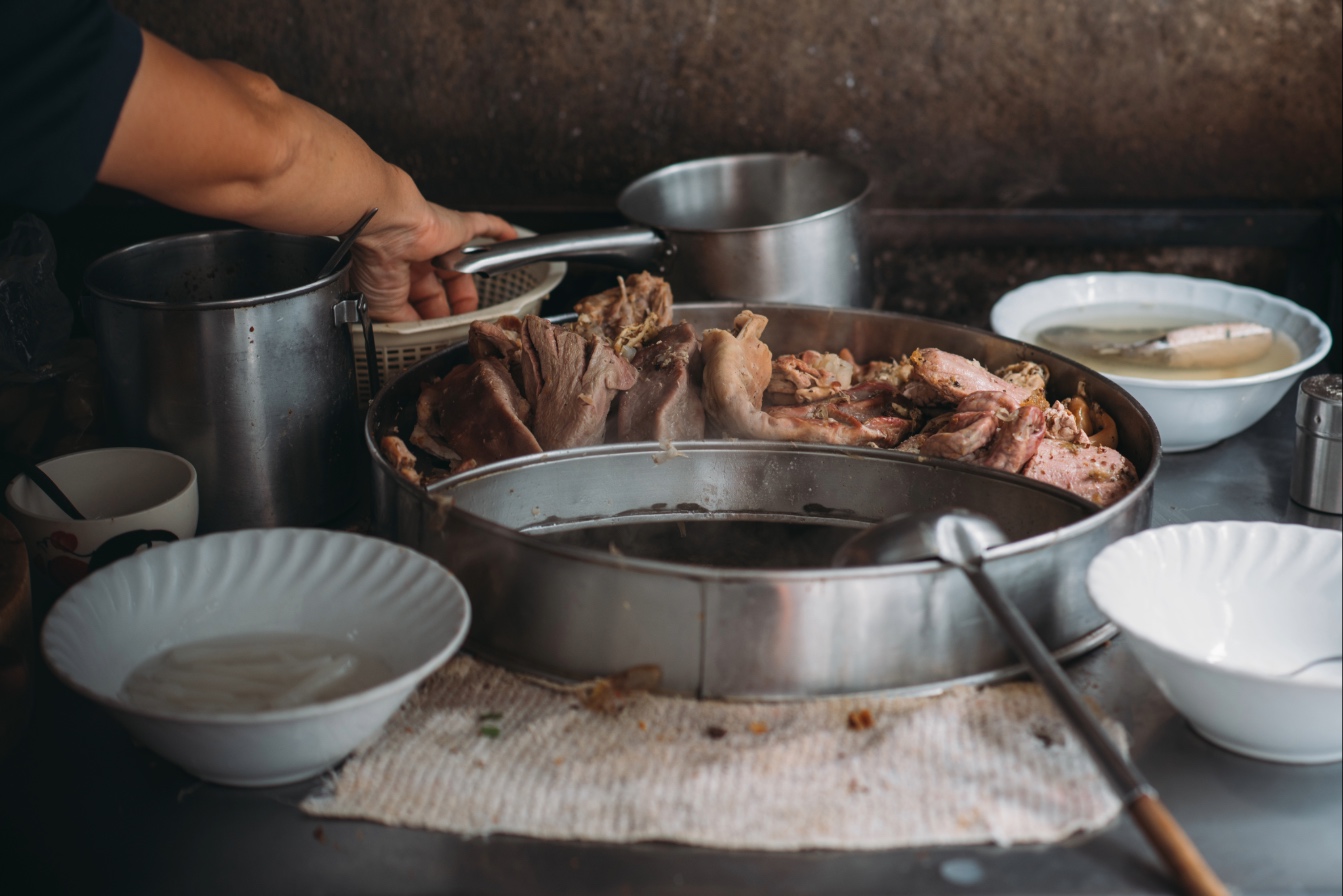
The stuff that doesn’t entertain tourists but feeds neighborhoods
STREET FOOD ECONOMY AND NEIGHBORHOODS
Bangkok’s chaotic growth was characterized by lack of planning as well as the lack of social welfare. Selling food on the streets became social welfare. The authoritarian state held down rice prices through export taxes which kept urban food cheap and wages low, and pushed rural migrants, especially from Isan, into the capital’s informal street-food economy. Bangkok’s dense street food economy grew as cheap, fast food for a rapidly growing working population. It is a product of urbanization, not a tradition. It became the employer for hundreds of thousands of people and the food security for millions living in small rooms without kitchens on a minimum wage. Cheap street food basically subsidized private sector wages. Street food wasn’t made for tourists but it was also not only for the poor class. Many street vendors became institutions, legends in their own right and some opened successful restaurants. Their folding tables were gathering places for both regular workers and business people alike. When I moved to Bangkok in 2003, the city was teeming with energy and activity. Densely populated neighborhoods like Pinklao, Jarunsanitwong 35 and countless others that emerged in the 1970’s and became hyper densely populated were bursting to the seams with vendors and foot traffic. Bangkok counted hundreds of such street food clusters. Today many of them have disappeared or have been reorganized through stricter regulation and it seems that the untouchable street food areas are those that serve tourists. When I moved here I’d say Chinatown’s Yaowarat Road was 80% locals and 20% tourists, now it’s reversed. Nightmarkets are popular destinations for both locals and foreigners, serving different styles of food depending on clientele. Street food has become a driver for tourism growth and it seems that it has become a tool for tourism marketing and part of entertainment rather than the embedded infrastructure that feeds neighborhoods which is its traditional role. Regular no-fuss street food still survives in some neighborhoods, but the trend points to less ubiquitous, more regulated and in the long run maybe pushed to the fringes of the city.
The question is what draws you in and what are your expectations? The colorful loud spectacle of street food tourism or the everyday street food of locals? Street food can be many things. Outside tourist night markets, what visitors now experience as “authentic Bangkok food” is a product of this 1960–2000 period I detailed earlier. That includes the street stall, plastic for convenience, cheap chicken, jasmine rice as the default rice, sugar in everything and Isan food everywhere. These things are not old or a tradition, but they are an urban necessity, deeply real and they evolve. You’ll find dishes that have been around since our grandparents’ generation but also stuff that young people like, such as crepes, waffles, sushi and burgers. That’s the beauty about Bangkok, it’s the free reeling spirit of taking what’s best and delicious and making it accessible to everyone. That’s what makes it challenging to decide where to go and what to eat. If you asked for my personal favorites or where do I take guests for street food? There are many but my final answer would go back to the roots of Isan migration if we go out at night.
Isan food – the flavors of the northeast
People from Isarn had been living in Bangkok years before the Americans arrived. Working as rickshaw drivers, servants in wealthy homes, etc. with the first restaurants open in the vicinity of the Ratchadamnoen Muay Thai stadium in the 1950s. Back then Isan food was marginalized and stigmatized as the food of the poor. The food culture reflects the condition of the Isan region which is a large arid plateau that suffers from droughts and is scarce in resources. Isan cooking relies on less fuel, there’s no cooking with fat such as stir frying. Instead slow cooking, boiling and grilling over fire. Traditional proteins include small animals such as frogs, birds, insects and of course fresh water fish or chicken depending on region. Dishes are served salad style, spicy and eaten with sticky rice and fresh herbs. Additionally the Isarn region has its own versions of grilled or cured meats such as sai krok isarn (fermented isarn pork sausage), soups and relishes or dips. The flavor profile is on the sour and herbaceous side, it’s also more spicy and pungent than central Thai food. Kanom chin (fermented rice noodles) is also eaten in beloved street food dishes such as tam sua. The larb or nam tok (a spicy meat salad) is another culinary megastar and one of Spiderman’s favorites. I highly recommended catfish larb (larb pla duk) and of course larb moo tawd the fried larb meat ball version. Dishes often have two versions: Pla ra which is Isan’s signature ingredient, a fermented fish sauce made from freshwater fish, toasted rice or rice bran and then the Bangkok version with lots of fresh lime juice, palm sugar and fish sauce. It was maybe the pungent smell of pla ra or the tradition of eating raw beef that kept native Bangkokians at a distance.
During the early stage of mass migration from Isan in the 70s, initially many Isarnians stayed only periodically in Bangkok, returning to their rice fields during harvest and planting season. While the food reflected the economic class system of Bangkok the cuisine has established itself as the people of Isarn began to permanently settle here, bringing their families, becoming entrepreneurs and fully fledged Bangkokians. Today, nobody really associates Isarn food with poverty or for being uncivilized, quite the opposite. Their flagship dish – papaya salad has evolved its own Bangkok version Som Tam Thai in addition to the original Som Tam Pla Ra. Som Tam is one of two unofficial national dishes that symbolize Bangkok’s working class. The other being the Thai-Chinese blue and white collar worker’s pad krapao (stir fried basil). They are served in more than 10,000 isarn restaurants and stalls, whether air conditioned and franchised or still as a small cart at a gas station serving both Isarn workers and every Bangkokian regardless of class.
The second street food category that reflects the late 20th century mass migration and that are a daily staple for lunch and breakfast are khao gaeng shops.
KHAO GAENG – THE THAI FAST FOOD
Bangkok’s economic boom years in the 1980s and 90s drew millions of people. The majority came from Isarn but substantial numbers also came from the south and the north of Thailand to work and study and what would you miss most from home? If your answer is your mother’s cooking then khao gaeng shops would be the place reminding you of food from home. Khao gaeng means rice and curry but it’s more than that. Khao gaeng is an indispensable pillar in our everyday food culture. It’s the Thai version of fast food but unlike western fast food it’s healthier, cooked fresh, it’s fast, it’s cheap, ubiquitous and dishes reflect the diverse regions and can include a northeastern larb, central Thai coconut based curries, Thai-Chinese stir fries, fiery southern curries, classic Teochew kai palo, relishes such as northern nam prik ong and many other dishes that would remind you of your mother’s cooking at home regardless what corner of the country you’re from.
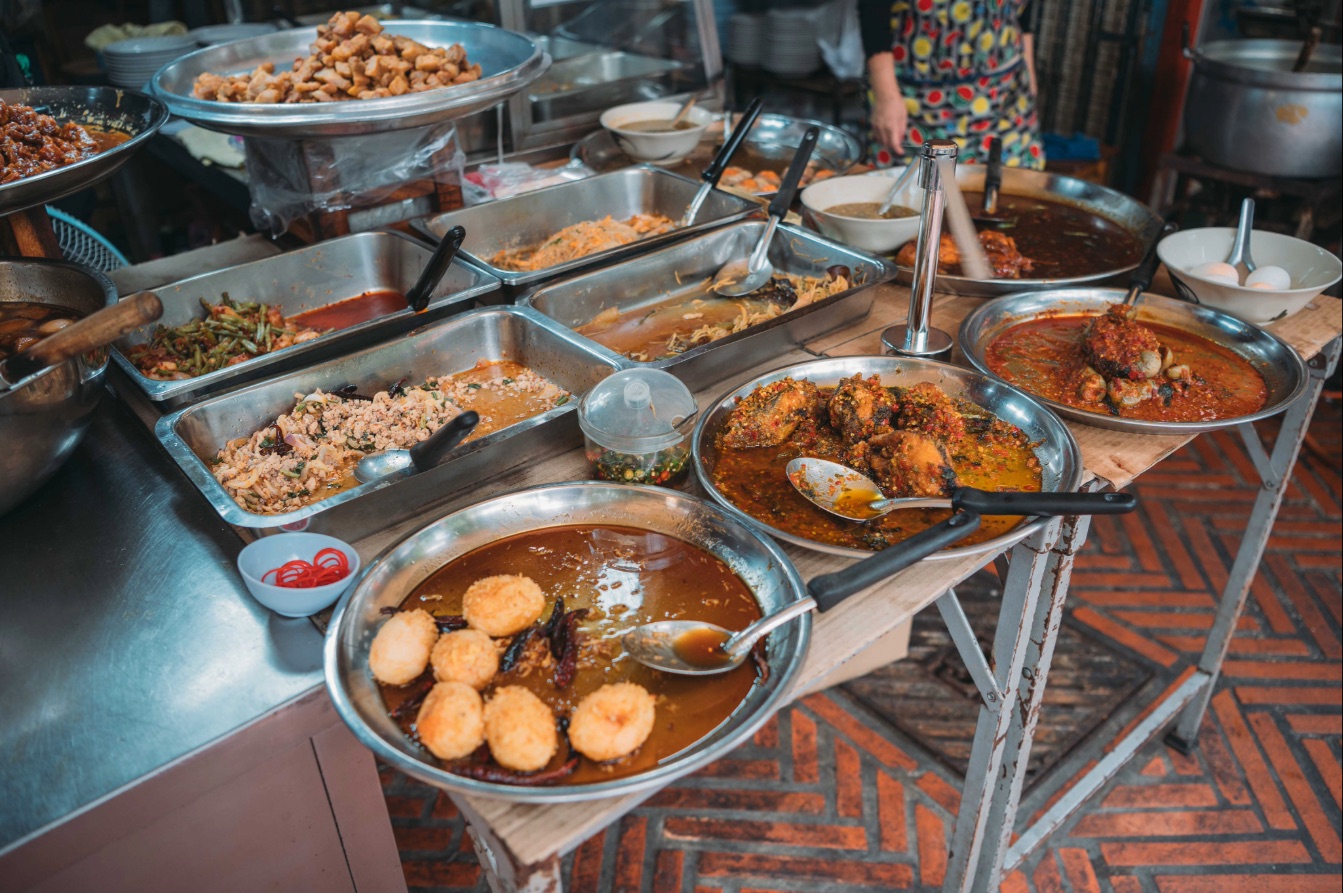
Khao Gang shop in a local market
Khao Gaeng is popular not only with labor but office workers, managers, students, literally anyone in need for breakfast, lunch or dinner, eat in or take home. You’ll find it in markets, cantines and open front shops. The food is cooked in the dark of night and early morning before serving and placed in pots and trays, a giant spread of colorful and aromatic dishes that are eaten with rice. Imagine Subways, instead of bread, get a place of rice, choose your favorite topping – green curry? Omelette? Chinese sausage? Mixed stir veggies? A small bowl of tom yum? Create your mini-samrab on a single plate and that’s our breakfast, rich and filling and gets you started for the day. A plate of rice and a single topping can go for 40thb (1 euro) with 20thb for each additional topping. It’s cheap and it’s not the “high-cuisine” of Thai food, few khao gaeng places are mindblowingly good, most are ok. This does not mean that khao gaeng is bad, but they’re levels to it. I don’t expect that they cook on the same level with the care and love of my mother in law but those khao gaeng places I came to love are a real treat.
Among the khao gaeng shops there is one category that hails from a particular regional cuisine and just as pla ra has spiced up balanced central Thai food, Thailand’s south is here to level up the heat for all lovers of spicy food.
SOUTHERN THAI FOOD
SOUTHERNERS TURNING UP THE HEAT IN BANGKOK
The first influences reaching Bangkok from the Indian ocean world were the Persians, massaman, the Javanese Satay and the beautiful khao mok which lean heavily on warm, dried spices, turmeric and are defined by historical, long-distance maritime trade with Persia, India and the Arab world.
In the context of mass migration of Thailand’s industrial age a second wave of southern culinary influences reached Bangkok’s stoves that of Malay influenced flavors from Thailand’s south. Thailand’s south is predominantly Muslim with its own culinary traditions and strong influences from Malaysia. Southern food bypasses the sweet aromatic flavors in favor of intense chilies, pungent ferments and the use of fresh herbs. If white represents the Chinese culinary influence (rice noodles, tofu, etc), yellow stands for southern dishes for their generous use of turmeric. So, while we think of lush tropical islands, beaches and limestone rock formations when we think southern Thailand I encourage everyone who has a respectable heat tolerance to level up their game and seek out some of Thailand’s iconic dishes such as gaeng tai pla (fish entrail curry), krua kling (spicy dry meat curry), pad sataw (petai beans stir fried in shrimp paste with shrimps) or gaeng som (yellow or sour curry) which is one of the signature dishes brought to the royal court in Bangkok by a princess of Nakhon Sri Thammarat after marrying King Chulalongkorn. It was the harbinger of the south’s sharp, sour, salty and fiery flavors that were to arrive in bright yellow colors in Bangkok’s kitchens a century later.
NOTE: please note that each section is only a preliminary introduction and we will dedicate more elaborate articles and content on each section as our research progresses.
Flavors of the northern mountain kingdoms
While central, isan and southern food are regular staples, the least common variation of regional Thai food is the northern version. The food is rooted in the rainforest covered mountain world of Thailand’s north, Laos, Myanmar and southern China. For most of its history this region was a kingdom in itself, a different country that cooked completely different from Bangkok’s definition of Thai food. Chiang Mai was a kingdom known as Lanna, founded in 1296 with its own script, Buddhist lineage and own court. The Lanna kingdom’s trade and migration was facing Burma and China rather than south to Bangkok. Chiang Mai was in the gravitational pull of Yunnan, the Shan states and Burma and fell under Burmese control for centuries. It eventually became a tributary and then directly administered from Bangkok in the late 19th century. That’s when the first northern flavors such as Miang kham came to the royal court of Bangkok and it took a century until the north’s best known dish khao soi conquered the Thai capital. The cuisine of the north is shaped by mountain valleys, forests, a genuine cold season instead of the humid Chao Phraya delta, Chinese junk trade and the royal palace. Like people in Laos and Isan, the northerners eat sticky rice, khao niao as its staple. As a landlocked kingdom the north also has an assortment of cured meat and meat preservation as well as grilled sausages such as (sai ua), noodles and namprik such as nam prik ong or nam prik num but several famous dishes that now define Chiang Mai were brought by people who were never Lanna’s core population such as the northern comfort food Khao soi.
In Bangkok’s food landscape northern food is few and far between compared to the plethora of the food we mentioned earlier. But the north is still present, especially the legendary curry noodle soup khao soi which has gained immense popularity and shifted from hard to find specialty into a mainstream city wide staple. Khao soi gained massive following through venues like khao soi kitchen during the pandemic and viral Chiang Mai born brands like Khao So-i which expanded into high profile location in Bangkok including Silom, Siam Paragon, etc. turning the dish into a trendy specialty or casual dining. In trendy places you can find khao soi served with Wagyu beef or korubuta pork making it a gourmet experience. Global rankings such as Taste Atlas named it one of the top traditional soups and noodle dishes in the world further pushed by tourist enthusiasm.
The rise from the fringes of Bangkok’s culinary landscape to eventually share the center stage is the story of Bangkok’s migrants and the democratization of food. What was once sold at construction sites and gas stations to workers made it to airconditioned restaurants in shopping malls and serves the middle class and tourists and shopping malls have become important hubs for retails, leisure, entertainment and food.
FROM FLOATING MARKETS TO MEGA-MALLS
In 1973, around the time when my mom took the bus to Bangkok to find a job, Siam Center opened as Thailand’s first international standard mall. The city already had department stores in the 1950s such as the Central Department Store Wang Burapa followed by the Nightingale Department store in 1966 but nothing compared to what was to come two decades later.
The 1980s saw Japan and the tiger states shifting car and electronics production to Bangkok turning Bangkok to the Detroit of Asia. Additionally billions of FDI were poured into massive infrastructure and real estate projects. Bangkok went vertical with the first highrise buildings such as Baiyoke 1 Tower, Bangkok Bank HQ and the Chokchai Building. The economy boomed and Bangkok’s growing population with money to spend moved from shopping and eating outdoor to indoor. Just as driving a car, dining in malls became status. In light of a rising middle class Bangkok’s shopping mall developers, in typical fashion, tried to out-built each other under the U.S. mantra: big is great. Because malls enhanced the status of Bangkok as a prosperous global city. The massive Central Ladprao Mall opened in 1983. Then Asia’s largest mall MBK (Mahboonkrong) Center opened its doors in 1985 and was surpassed by the World Trade Center 4 years later. Less than two decades after commerce moved from riverine floating markets to land, malls were built that surpassed anything I had known from Germany. I come from a culture where the mantra is small is beautiful and all I knew was Kaufhof in Köln and Karstadt in Hückelhoven, so when I arrived in the early-mid 1990s I was in complete shock, albeit a positive one. The U.S. troops were long gone but the American spirit of economic policy and grand spectacle still lingered. I still remember how American Bangkok felt as so many highrises soared from the dust of former slums, farmland and rural villages forming Asia’s largest overall construction site. Billboards with U.S. and Japanese brands, giant shopping malls and towers bearing names such as Times Square, World Trade Center, The Mall Bang Khae or Central Pinklao where traffic jams from hell crawled past on ten-lane roads flanked by electric wire chaos. When the malls arrived in the 1980s they introduced supermarkets and international fast food chains such as Thailand’s first Mc Donalds at Amarin Plaza in 1985 or Swensen’s Ice Cream and brands that are now gone such as TGI Fridays. When the development accelerated in the 1990s it turned Bangkok into one of Asia’s prime shopping destinations, boasting 3 out of the 10 world’s largest shopping malls which consume as much electricity as small countries and Bangkok keeps building new ones. For Bangkok megamalls are an important part of the tourism offering and occupy an important space in the evolution of urban life in Bangkok. For us Bangkokians they are the refuge for leisure, shopping, lunch time break, movies and more. Bangkok is a city with an intense heat, monsoon, humidity, pollution and insufficient public space, hence you can view malls as our town squares, a cool and clean space hub where global consumerism converges into temples of instant gratification. Roughly 40% of the gross leasable area is dedicated to food and beverage concepts. Besides retail, edutainment, franchise restaurants, top culinary brands, gourmet markets and massive food courts are a magnet that make both Bangkokians and tourists feel like Alice in Wonderland. I buy my sour dough, go for Korean Bonchon chicken or grab a burger from Shake Shack, slurp a khao soi at the food court and wash it down with a Mango Grapefruit Boom from Heytea. Of course, you’re not here for Japanese style burgers from Shanghai based Niku Niku Oh Kome sold at Siam Center! But this blog is about Thai food and for those who want to spend their money locally but an overview of Bangkok’s food culture would be incomplete without the role malls play.
THAI FOOD – SOFT POWER AND TOURISM ENGINE
The authority which defined Thai food shifted from the aristocracy to the state to the first food critics and since the turn of the 21st. Century increasingly back to the state and social media food influencer. The historic influences of trade and migration that fueled culinary innovation for centuries and elevated Thai food to its refined and balanced complexity shows a multi-cultural roots. Today, this regional fusion of ingredients and traditions is repackaged as Thai food and associated with central Thai food which is the seat of our monarchy. Given the role of the Buddhist monarchy as an essential part of Thai national identity, eating Thai food is to experience Thainess. Just as in the day of Phiboon Songkhram, food is imbued with nationalist ideology to unify the nation, instill pride in being Thai and exert influence globally. What began in the 60s and 70s with Thai students, migrants and tourism spreading Thai food abroad, evolved in the early 2000s’ push to export Thai food as soft power with the “Global Thai” and “Kitchen of the World” programmes to make Thai food a global brand. At home food critiques and the precursor to food blogs such as Shell Chuan Chim, validated and certified Thai food businesses with logos of trust. This was taken to a new international level in 2017 through a collaboration between the Tourism Authority of Thailand and the Bib Gourmand Michelin Guide to boost Thailand as a world-class gastronomic destination.
Since tourism is a crucial pillar for Thailand’s economy the perception of Thai food among foreigners plays an important role. Our social media algorithms flood us with food content and they become a tool in deciding where and what to eat next. My wife and I regularly send each other food videos to try out new places and a lifetime is too short to try them all. That leaves the question for you what and where to eat if you’re in Bangkok only for a couple of days. Food tours are a great option and there are several specialized food tour operators in Bangkok.
From the best Phad Thai to the most authentic pad krapao. Are you new to Thai food, are you an experienced eater? That’s why I tried to categorize Thai food into different layers of Bangkok’s culinary landscape. Culinary layers that one after another engraved themselves into the DNA of Bangkok’s food culture and I believe that most of the dishes this article links to go beyond what we know from Thai restaurants in the west. To explore each layer I will add and link dedicated articles and update it step by step. I have my hands full managing tour operations, designing and leading tours myself therefore you have to give me some slack but I sincerely hope this article inspires you to explore and will help you to find new gems in the culinary landscape of our city. For questions or more details, feel free to follow us on social media, reach out to us or join us into the backstreets and kitchens of Bangkok.
IMPORTANT: This blog is work in progress and far from complete. The list of topics shown here will be given their dedicated articles as research progresses. Follow us for real time progress on content relating to Thai culinary culture.

Bangkok-based experience designer, blogger, tour guide and hobby anthropologist. Founder of bangkokvanguards and Hyperlocal.
I’m exploring and bridging my Asian and Western roots by exploring and introducing you the places, people and ideas that matter and connecting them to experiences and projects around culture and sustainable development.